
Book Proposal for Critical Essays on We the Living
(With an Annotated Bibliography and Analysis of Soviet Ukraine)
Word Count: 173, 377 (Book Published) Author: Emre Gurgen
- Description (Brief)
- Merits
- Selling Points (Features)
- Marketing (Publicity)
- Platform
- Target Market (Market Analysis)
- Timeliness Statement (Ukraine-Russia War)
- Timeliness Statement (US Politics [Donald Trump / Zoran Mamdani]);
- Timeliness Statement (Marxism in America: [Hassan Piker])
- Timeliness Statement (Modern Russian Suppression Resembles Soviet Suppression)
- Synopsis
- Book Series (11 Books)
- Author Bio
- Why Emre Should Write This Book (He Lived in the Former Soviet Union)
- Competition
- Peer Review (Historian)
- Call to Action (Read Introduction)
I. Description:
Critical Essays on Ayn Rand’s We the Living is a comprehensive trade-scholarly analysis of Ayn Rand’s first novel, which examines the historical, political, and philosophical foundations of early Soviet Russia (1922-1925). Drawing on close textual analysis and historical documentation, Gurgen presents We the Living as a powerful literary indictment of collectivism and totalitarian rule. That is rooted in lived experience rather than statistical abstraction. Because it shows readers—through personal stories not political debate (or abstract analysis)—the reality of life under Soviet Communism.
Functioning as both a critical guide to We the Living, and a broader study of how Soviet ideology reshapes—and ultimately destroys—human life, Critical Essays investigates Rand’s most personal novel from a broad perspective. By depicting an easy-to-understand written lesson on State tyranny that portrays a cast of highly believable characters trying to live for themselves in the face of great oppression.
Situating Rand’s novel in its real-world Soviet context, Gurgen’s book ultimately shows readers how Russia’s history of state controls and collectivized activity inevitably dismantles individual freedom, morality, culture, and personal identity. As characters struggle helplessly to be who they are in the face of a collective regime that pulverizes lone thinkers.
Basically, Gurgen’s book outlines how Communism degrades people’s everyday lives. In big ways, like breadlines, that people readily comprehend—but do not fully understand—and in small ways—like the lack of habeas cadaver—that most people are completely unaware of.
II. Merits:
1) Timely (Ukraine / Russia War):
Connects to today’s headlines and news cycle by showing readers why Ukrainians are fighting so hard for their freedom, dignity, and human rights. Specifically, my book shows—both in We the Living’s plot-line and historically—how the Soviets violated the Ukrainians. By committing crimes against their humanity, crimes against their physical-and-mental peace, crimes against justice owed to them, and crimes against their human spirits.
So, one of my book’s main selling points is the light it casts on the current war between Ukraine and Russia. Since, it shows readers, both in We the Living & in Russian history, how the Soviets stripped Ukrainians of their human rights.
Similar, to how Putin is dehumanizing Ukrainians today. So, he can murder Ukrainians without compunction; without suffering guilty feelings.
2) Timely (Putin’s Russia & Soviet Russia):
Meets the needs and interests of the present by outlining how modern-day Russia is becoming like We the Living’s Soviet Russia.
3) Comprehensive:
Broad (covers over 150 Soviet topics);
4) Intellectually Contributes (To AR Studies):
Since, Emre presents a radically original new look on well-worn material that intellectually contributes to the field of Ayn Rand studies, his book will appeal to intellectuals ready for a new take. Because instead of recycling old idea about the novel from a shared point-of-view, my book is an extensive think-piece that articulates fresh ideas from controversial angles.
In fact, nobody has written a book about We the Living that is as comprehensive as Emre’s. For Emre’s book goes far beyond explaining the novel (in a basic way) to high school (or college) students. Rather, it shows, in specific ways, the entire range of how Soviet’s close down society, by shutting-down human beings.
In sum, the depth-and-breadth of Emre’s book, coupled with his vivid psychological insights, makes his work the deepest book ever written on We the Living and maybe even on Soviet Communism. (At least in some ways).
5) Reaches Elites and Influencers:
A serious, timely, controversial thought piece that will motivate classically liberal intellectuals, who hate dictatorships, to buy, read, and recommend Emre’s book to their personal and professional networks.
Similarly, it will also spur conservative thinkers, who hate Communism, to either share my book with their fellows, or leave honest online reviews, or ask me to speak on their shows, or take some other unanticipated action beneficial to me and my book.
In sum, the valuable content of Emre’s book will eventually spawn important conversations—around We the Living, the Soviet Empire, and today’s Russia-Ukraine war. In a manner that reaches elites and influencers.
6) Original Theses:
Emre’s book is governed by an all-controlling thesis as the basis for selection, with only one main idea per essay. Thus, because Emre’s book asks questions and provides answers, it does not just topic cover, as some We the Living criticism does. Instead, Gurgen’s book makes serious arguments, from start-to-finish, by advocating a variety of clear, significant, persuasive arguments.
In other words, Emre’s book does not merely repackage what has already been written on Rand before. Adding only a few new ideas, here-and-there, for variety. Rather, Emre’s book is unique, sui generis, even.
Because it has a variety of clear and uniquely insightful theses; because it always loops back to the author’s main argument; because it provides no useless summary that could detract from Emre’s claims; because it uses convincing evidence, including references to and quotations from the text that are interpreted rather than merely cited; because it features paragraphs that are unified, coherent, fully developed and in logical order; and, lastly, because it uses eloquent writing that is not only grammatically correct but also stylistically superb, especially in terms of clarity.
7) Footnotes (not Endnotes) [Easier to Understand]:
Explains background information in footnotes—that appear on the bottom of the page—not remote endnotes that are hundreds of pages away; at some obscure location at the back of the book.
Thus, when Emre writes about background issues—Soviet history, Ayn Rand’s Soviet life, global communism, etc.—he drops footnotes directly below the paragraph. At the bottom of the page. Where readers can easily read these explanations. Because they are within a reader’s visual range, or eyesight. Conversely, Emre does stick obscure end-notes at the back of the book, which makes less sense to readers, because of their remoteness.
Rather, Emre purposefully puts 240 clarifying footnotes under the textual references (or paragraph’s) they explain. Thus, making it easier for readers to connect the content of Emre’s essays with relevant, easily accessible, background information. (Few readers consult endnotes). In other words, Emre’s juxtaposition of needed information so close to the body of his work makes is easier for readers to see (and process) the information they are looking for.
8) Focused:
Emre’s book does not constantly break into side references, all the time, in the main body of his book. Nor does he input background information directly in the body text—long tangents into Ayn Rand’s life; long digressions into Russian history; long detours into Rand’s family; long deviations into Ayn Rand’s other books, etc. Explanations that though interesting and articulate, ultimately destroy a coherent analysis. By always disrupting (and interrupting) a readers’ focus with jarring side-references integrated directly in the main body of the text. Instead, Emre drops this information into footnotes. Rather than constantly interrupting the reader’s logical train of thought.
Thus, because Emre’s book is more a direct explanation of We the Living, with footnotes to handle side references, it is more focused than my competitor’s book.
9) Book Based:
Analyzes We the Living from a text-centric line of reasoning, not a context-centric method of argumentation, by analyzing what is inside of the book not what is outside of it. In other words, by employing an empirical process that marshals-and-positions interpretive book facts to prove a satisfying central argument, Emre’s book initiates and sustains a provocative discussion on We the Living’s internal content—not on external material. Thus, establishing a factual basis for his claims that flows from incontrovertible book facts.
11) Will Change How People Think About We the Living:
May change the way scholars think about We the Living by challenging received academic opinion.
12) No Jargon, Technical Terms, or Obscure Words (Emre Writes to be Understood):
Emre’s book does not use shorthand terms, technical words, or arcane jargon that only the initiated will understand. Rather, it presents jargon-free prose that anyone with a college degree can easily comprehend. For Emre writes to be understood by people who want to read clear documents. Thus, to achieve this goal, Emre does not use little know (and lesser understood) field-specific words that only hard-core scholars (with million-word vocabularies) will ever use or understand. Instead, he uses more accessible language, to communicate a clear message of sorts. That will be understood by professional (and laymen) alike. Who all want to read clear books with straightforward, fearless, messages.
13) Universal (Speaks to all People):
Emre’s book speaks to people from all walks-of-life, backgrounds, and living conditions. By suggesting that what makes people human is their need for their own mental freedom, emotional liberty, and physical security, so they can be who they are, unrestrainedly. Without strict regimentation over every aspect of their lives.
Indeed, the vivid parallels between the lives of We the Living’s 81 characters, and what most people want from their own lives, strikes a particular cord within us. By encompassing a wide range of human experience, we can all identify with and relate to.
Thus, people who read Emre’s book will find something that speaks to their needs. Because they are also members of the human race, who care about the same things “We the Living’s” characters care about.
III. Selling Points (Features):
1) Returnable:
(Libraries & bookstores can return unsold copies to Ingram. [Marked returnable on Ingram’s website])
2) Discounted:
(Libraries & bookstores can order Emre’s book at a steep discount [55%])
3) Definitive Companion to We the Living:
(Synthesizes a great amount of information)
4) Deeply Researched & Authoritative:
(Supported by research of Ayn Rand’s experiences living in Saint Petersburg, Russia, from 1922-1925 / Reinforced with Soviet research / Authoritative because backed by quotes from 161 different reputed scholars who are well-respected in their fields / Uses approximately 150 different sources / Including books, articles, documentaries, blog-posts, diaries, letters, interviews, speeches, biographies, reports, the Soviet penal code, Soviet websites, student transcripts, newspaper articles, magazine clippings, specialized encyclopedias, dictionary entries [and more])
5) Historically Grounded:
(240 footnotes on Soviet events, persons, and movements that We the Living references)
6) Essential for Serious Readers:
(A serious reader is a deeply engaged reader who reads critically, usually for information, not just entertainment. Accordingly, serious readers do not consume texts passively. Instead they actively engage with – and process – their reading. By thinking about it deeply. Further, serious readers are bibliophiles who devote a significant amount of time, energy, and focus, to reading books. Thus, a serious reader fully concentrates on what they read. By actively engaging with their books. By taking notes, underlining key ideas, and reading analytically. Since, serious readers are thoughtful readers who do not passively absorb shallow texts by skimming. Instead, serious readers are deep thinkers who read substantive books deeply, since they take themselves—and their values—very seriously)
IV. Marketing / Publicity:
1) Book Banner Advertising Campaign (Amazon & Ingram):
- 24/7 Promotions (Amazon & Ingram banner ads);
- Amazon Ads (500, 000 guaranteed ad impressions);
- Ingram Ads (single-slot ad in a special landing page);
- Advertising on a popular website (Amazon);
- Advertising on a specialized website (Ingram);
- Ingram’s ipage is an online search and ordering platform used by over 50, 000 retailers, librarians, and educators around the globe;
2) Google Advertisements (3 Months):
- Targeted Google ad campaign;
- Ads placed on sites within the Google display network;
3) Video Book Trailer (Premium):
- Creation of a custom-made book video;
- 90 seconds long;
- Voiced by a professional actor;
- Video distributed to u-tube;
- Two live action clips;
- Own rights to video file;
- Can share with readers, friends, and family;
- My promotional video will put my book in front of myriad new eyes;
- Will convert some of those new eyes into paying customers; into book buyers.
4) Video & Podcast Interview on the Book Connection:
- 15-minute video interview (pre-recorded) on The Book Connection Show, which is an online video podcast dedicated to up-and-coming self-published authors;
- Emre’s interview will be on the “Author Round-Up” segment of The Book Connection Show;
5) Creation of a 6 Page Sub-Website (Dedicated to Emre’s We the Living Book):
- Creation of a 6-page sub-website dedicated exclusively to “Critical Essays on We the Living;”
- This sub-website complements Emre’s main (19-page) website: https://aynrandanalyzed.com/
6) Press Release:
- Customized one-page press release;
- Delivery of press release to a minimum of 100 media outlets;
- Will submit to appropriate media outlets based on location, interests, and viability;
- Will submit to online publications, magazines, newspapers, radio and tv shows;
- Hyperlinks to Emre’s book’s promo-video will distinguish his press release from his generic competitors;
7) Promotional Materials (Social Media / In-Person)
- Customized Book Banner Ads (Facebook, Instagram, X);
- Book Stubs (Plastic Card / Book Cover [Front] / URL to Free E-Book Download [Back]);
- Flyers; (Full-color image of book cover, author name, book title, and detailed event information [date, time, location]);
- Posters: (Large 12 x 18 format / Laminated Poster / Book Cover
on Front / Empty Space for the Event’s Date and Location on Poster’s Bottom); - Bookmarks; (Full-Color Design / 2” x 8” / Front Book Cover / Back Website URL & Description);
- Postcards; (Custom Designed, Full-Color Marketing Tools Used to Promote my Book by Displaying my Book’s Cover, Title, Author Name, and Purchase Links / Marketing Materials for Book Signings, Networking, and Mail Campaigns);
- Business Cards; (2” x 3.5” Color Marketing Tools / Features a Book Cover Image, My Name & Contact Details [email/cellphone/website) and Social Media Handles)
- Social Media Announcement (Book Launch Notice on AH’s Facebook, Instagram, and X Pages);
V. Platform
Emre’s Platform (Strong Platform & Recognizable Brand)
Emre is building a robust brand & a sturdy platform. By delivering his books details to potential interviewers, journalists, librarians, bloggers, podcasters, influencers, and book sellers. To make it easier for these media professionals to write articles, create social posts, interview me, order and stock my books, and prepare to spotlight my books and person on their podcasts, radio shows, TV programs, and blogs.
Indeed, by participating in writers’ conferences, joining writers’ groups, creating e-mail lists, creating a U-Tube Channel, guest blogging, podcasting and interviewing, Emre will be able to build working relationships with editors and other authors. Until he becomes a national authority on Ayn Rand and her books.
He’ll do this by speaking at writer’s conferences; partaking in the writing community; sending messages directly to readers; recording video lectures on Ayn Rand and her books; creating precise content for people on their blogs and websites; answering people’s questions—by video, audio, or in writing—and by fitting his work into the marketplace. Until, Emre has more sales & contacts; a stronger social media presence; the ability to reach many readers directly; more speaking invitations; and a higher-trafficked website. Thereby, using enhanced visibility techniques to reach millions of readers directly.
Hopefully, these efforts, combined with the valuable content of Emre’s books, will cause people to invite Emre to speak about We the Living, Ayn Rand, Soviet Communism, and its impact on Ukraine, at many places, preferably as the key note speaker.
Emre’s Platform (Ukrainian Participation)
Emre hopes to sell more books by convincing the Ukrainian Cultural Affairs Office to purchase, translate, and distribute, thousands of his books to their citizens. So, Ukrainians fully understand why they are fighting so hard for their freedom.
Already, Emre gave his book to Ukraine’s US ambassador, Olga Stefanishyna, on May 2, 2026. During embassy day, where embassies are open to the general public.
In the coming months, Emre will follow-up on his initial outreach efforts. By contacting the proper Ukrainian authorities (perhaps the cultural attaché’s office) to see if the person in charge of purchase orders will buy (and translate) Emre’s book.
Emre’s Platform (Website, Social Media, Conferences, Book Stores, Book Fares, & Festivals)
Right now, Emre’s Platform consists of an elaborate Ayn Rand website, which is an essential resource for Rand enthusiasts (www.aynrandanalyzed.com) Through this website, Emre will sell more books to his target audience.
Gurgen also has several social media accounts (FB account, FB fan page, X-Page), through which he will also reach readers.
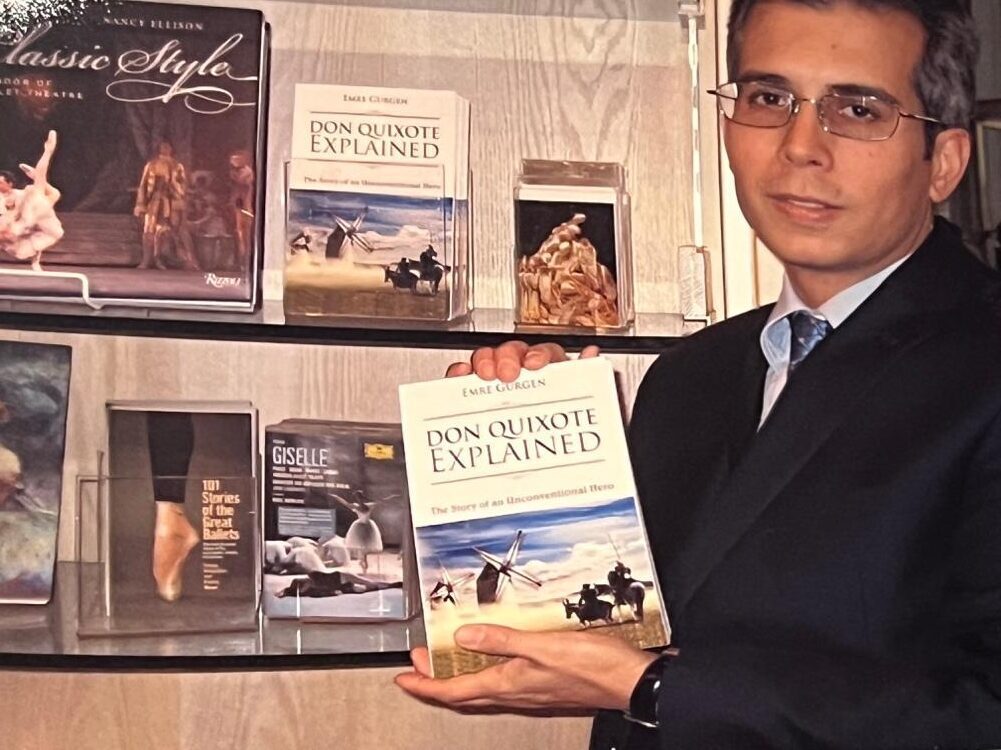
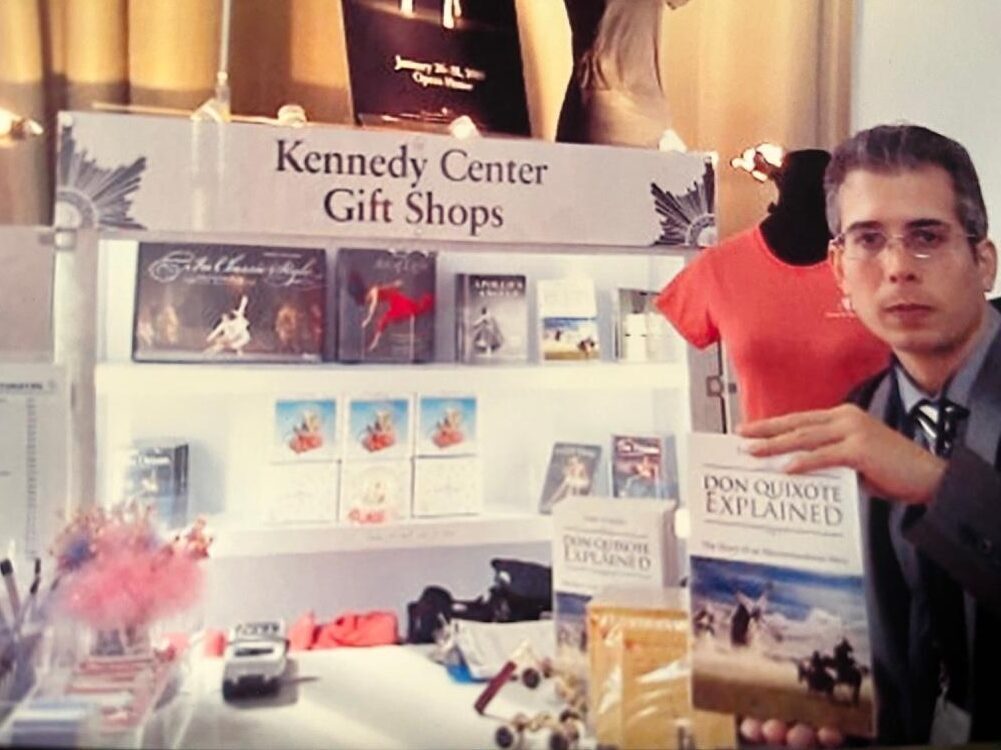
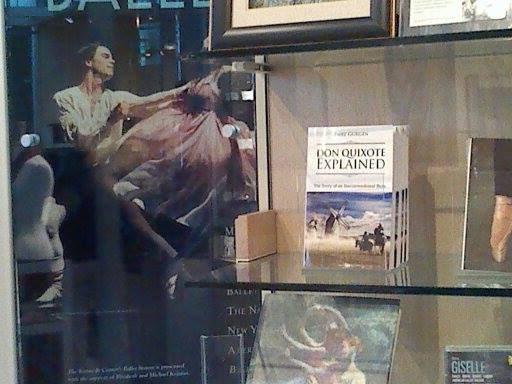
Additionally, in 2014, Gurgen sold one of his books at the Kennedy Center, in Washington DC. Where it was displayed for nearly a month, during the performance of a Don Quixote opera. Such a famous theater displaying Emre’s book for such a long time provides legitimizing social proof for Emre’s current title.
Similarly, since Emre sold his first two books at the Baltimore Book Festival – for 3 days in 2016 – Gurgen has a positive track-record for selling books at fairs.
Indeed, Emre’s participation in fairs, enhances his overall platform. By increasing his sales, visibility, and legitimacy.
To further enhance his platform, Emre will sell more books at these book fares:
- The Book Expo of America;
- Book Fest of Pennsylvania;
- The Bethesda Literary Festival;
- Amelia Island Book Festival;
- Fall for the Book;
- Fredericksburg Independent Book Festival;
- Gaithersburg Book Festival;
- Literary Hill Book Festival;
- Virginia Literary Festival;
- &, more.
in the next year, or two, (2026-2028).
1 Maybe, at one of these book fares, Emre will be discovered by an industry insider. Someone, who believes in him. Then, Emre’s career will grow, like a rocket, when he is traditionally published.
Further, Gurgen presented his first book, “Don Quixote Explained,” at the 41st International Conference for Hispanic Literatures, Don Quixote in the Humanities. At this conference, Gurgen was one of the only authors with a table—just outside the conference hall—where he sold books.
Cover Artist’s Platform (Enhances Emre’s Platform)
Since a book’s cover is the first thing readers see when buying a book, I hired a professional artist named Gavin Glakas, www.gavinglakas.com, to paint my book’s cover. So, I can generate more sales.
Indeed, Gavin’s active participation in his own self-promotion will deliver Emre’s book data to thousands of additional readers and book buyers.
For Gavin will use his well-developed (vigorous) platform to promote his first book cover. He’ll do this by sharing his painting with his Instagram and Facebook followers, his direct e-mail list, and with his audience on the Painting Insights podcast. He will also post Emre’s book cover on his highly trafficked website. Likely, all this sharing, will drive more sales.
In sum, Gavin’s Instagram & Facebook pages, his large e-mail list, his highly-trafficked website, and his regular participation in “The Painting Insights” podcast, will bring Emre’s book to the attention of thousands of additional readers. Some of whom will buy it.
Indeed, by putting Emre’s book in front of thousands of new eyes—especially the eyes of key decision-makers—Gavin’s self-promotion will help Emre reach more people; so he can sell more books.
Why Gavin?
Gavin painted Emre’s book covers (front-and-back) to make a good first impression on readers. Since, he is a great artist, with a significant following, that will draw more attention to me and my book. By painting a stunning cover that spurs readers to actually open my book—instead of passing it up—because its’ shell is so striking. Perhaps, even buying my book, when they learn that its’ writing is worthy of its cover.
In sum, because a book’s cover is the greatest marketing tool an author has to promote his books, I purposefully chose Gavin. Since, he is one of the greatest painters of our modern age.
Why Gavin’s Associates May Buy Emre’s Book?
Since, Gavin’s uncle is George Tennent , the former CIA director, I think that many of Gavin’s Facebook friends, Instagram followers, and people on his e-mail list, are in national security (in some way, shape, or form). Thus, because many of Gavin’s friends have serious careers detecting and dismantling threats to American freedom—the content of Emre’s book aligns with focus of their lives. Because they are entrusted with protecting the United States from all threats, foreign & domestic.
Thus, many of Gavin’s friends may like a book that speaks to their career interests. That teaches them a comprehensive understanding of global communism. So, they can dismantle communist threats to the US – and the world – before it is too late.
2 George Tennent is not involved in this and does not know me. I saw him once at Gavin’s wedding but did not talk to him. I mention him not to name drop (I hate doing that). But to show you the type of people whom I think may be in Gavin’s friend network.
So, even though the CIA is not involved in this in anyway—Emre’s books have always been his sole doing—I think the CIA may like my new book. Since, they are US patriots (like me) who love pro-American, anti-Soviet, books (like me).
Accordingly, when Gavin posts stuff about my book cover, perhaps some of Gavin’s chums may buy my book. Not just because Gavin painted its’ cover (that helps) but out of professional curiosity, mostly. Out of a desire to fully understand how Soviet Communism was (and still is) a great threat to American freedom.
In fact, many of Gavin’s friends may like my book. Because it helps them understand current affairs. By clearly explaining the ideological roots of today’s war between Ukraine and Russia.
Thus, Gavin’s friends may buy Emre’s book. Since, it not only speaks to their professional interests, personal needs, and security outlook—in a language they like and understand—but also because it is a politically incorrect work of non-fiction that undermines communism by keeping it real. By not apologizing for (or seeking to downplay) the crimes of Soviet Communism. But rather by exposing Communism for what it really is. Not what people hope, pretend, or wish it to be. (Such honesty, they will appreciate).
Accordingly, Gavin’s friends, family, and associates may buy Emre’s book. Because they also hate Communism like Emre does.
Cover Artist’s Platform (Specifics)
Gavin’s strong platform includes:
- A decent Facebook following—Gavin’s posts get hundreds of likes (within hours) from his 6.1K Facebook followers.
- An Instagram account with 87 K Instagram followers https://www.instagram.com/gavin_glakas/. To promote his new artwork, Gavin will produce a video of him creating Emre’s book cover (maybe time lapsed) that will increase Gurgen’s ability to reach readers. (Gavin’s similar Instagram Post—of him creating another painting—was liked 35.6 K times, commented-on 158 times, and shared 291 times).
https://www.instagram.com/p/DPEmMSoACX7/ - Besides Facebook & Instagram, Gavin also participates in a Painting Insights U-Tube Podcast that has 3.08 K subscribers.
https://www.youtube.com/watch?v=dzbt1SX76cE - Gavin has also been on a number of national news shows, including NBC News.
https://www.youtube.com/watch?v=4u9YtbTvMvM
3 The “Painting Insights” Podcast is an online show where Richard K Blades and Simon Renshaw talk to professional painters, gallery owners, frame makers, and curators. Gavin has appeared on this podcast many times, as a guest speaker.
So, Gavin’s high profile, advanced platform, and impressive honors, will help Emre sell more books.
Emre’s Platform (Specifics, Details & Social Proof)
Emre’s author website (www.aynrandanalyzed.com) returns first page Google results.
(If you type “Ayn Rand Scholars” in Google’s search engine, Emre’s site is the first result on the first page)
Emre’s website (www.aynrandanalyzed.com) is an essential resource because it has:
- A Scholars List: That cites the name, affiliation, and contact of over 230 scholars, together with what works they have written, what subject areas they study, their publication information, their dissertation and thesis abstracts, etc. Students and fans usually like this digital resource for scholars and fans. Because it helps them find professional Ayn Rand intellectuals who write about topics they want to learn about further.
https://aynrandanalyzed.com/ayn-rand-scholars/ - A Raw Data Section: Users can download Raw Data documents on all of Rand’s novels, novellas, screen plays, and stage plays. These fuller-length data collections—between 950-1230 pages—complement and enhance my shorter Reference Guides. Because they organize mostly all of Rand’s fiction in her own words. (Some, users have already downloaded this data).
Further, since these raw data documents are searchable, users can easily find what they are looking for by typing in relevant search terms.
https://aynrandanalyzed.com/raw-data/ - Bibliographies: Emre’s website has a bibliography page that lists what books, essays, articles and audio lectures, have been written on Rand’s novels, novellas, stage plays, and screen plays.
https://aynrandanalyzed.com/bibliography/ - Audio / Visual: All of Emre’s videos, slide-shows, audio, and pictures, will bolster the popular reception of Rand in the general culture and amongst the reading public. By engaging people who are audio / visual learners. People, who want to learn about Rand’s fiction through videos, songs, speeches, and audio book readings, given by Rand herself. Because they like seeing, hearing, and mentally chewing easy-to-digest videos, book trailers, and simple graphics. After which, they may read Ayn Rand’s fiction, and eventually purchase Emre’s books. Because Emre’s multimedia website appeals to their basic senses (sight-and-sound), which ultimately complements (and enhances) their reading experience.Also, since Emre’s website has a “Who is Ayn Rand” video users may enjoy watching this video. Since, it outlines who Rand was, what she believed in, why she was so controversial, and basically why she was loved-and-hated by millions. Thereby, orienting people towards a clearer understanding of Rand’s thinking.
Basically, my website will appeal to audio/visual learners; together with people who need to digest (or process) the content of Rand’s books through videos and music. So, they can better understand Rand’s thinking, through tactile means.
- More: Please visit Emre’s 19-page website to learn how his scholarship will draw in new audiences.
Basically, Emre’s intricate website is a hub for Ayn Rand Studies. Through which he will execute an active content strategy that brings readers to this digital doorstep.
Emre’s Social Media: (Facebook Fan Page / X Page)
(Since, social media is a way to create a natural book buying funnel, I plan to engage other people through social media)
X-Page (Just Created)
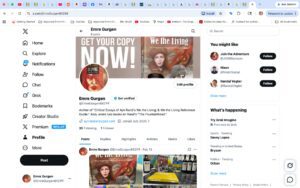
(X-Page)
Facebook Account
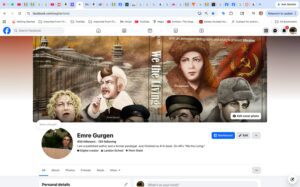
(Facebook)
https://www.facebook.com/sagitarrium/
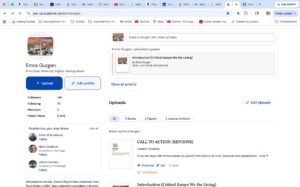
- Academia Account: (6, 392 Public Views / 2 Public Mentions)
- Sold at Kennedy Center (Washington DC)
(In 2014, my book, “Don Quixote Explained,” sold at the Kennedy Center in Washington, DC.)
Symposium Presentation
(In 2015, Emre presented at the 41st Symposium for Hispanic Literatures “Don Quixote in the Humanities”)
* California State University (Carson, CA, Dominguez Hills)
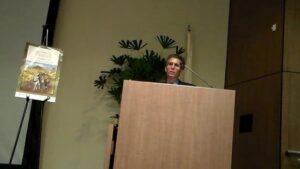
(Emre’s Symposium Presentation)
*Emre’s conference paper, titled “The Generation of the Renaissance in the Quijote” has been viewed 1, 370 times; bookmarked 90 times; and downloaded 200 times, on Academia.edu.
https://psu-us.academia.edu/EmreGurgen
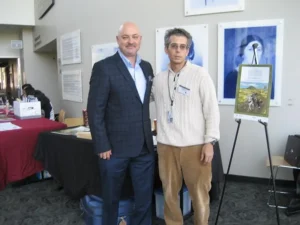
(Emre with Conference Organizer [Benito Gomez] Selling Books)
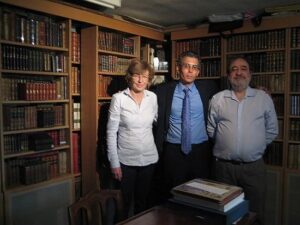
(Conference Related Investigations: 3rd largest private “Don Quixote” library in the world) (* Madrid, Spain)
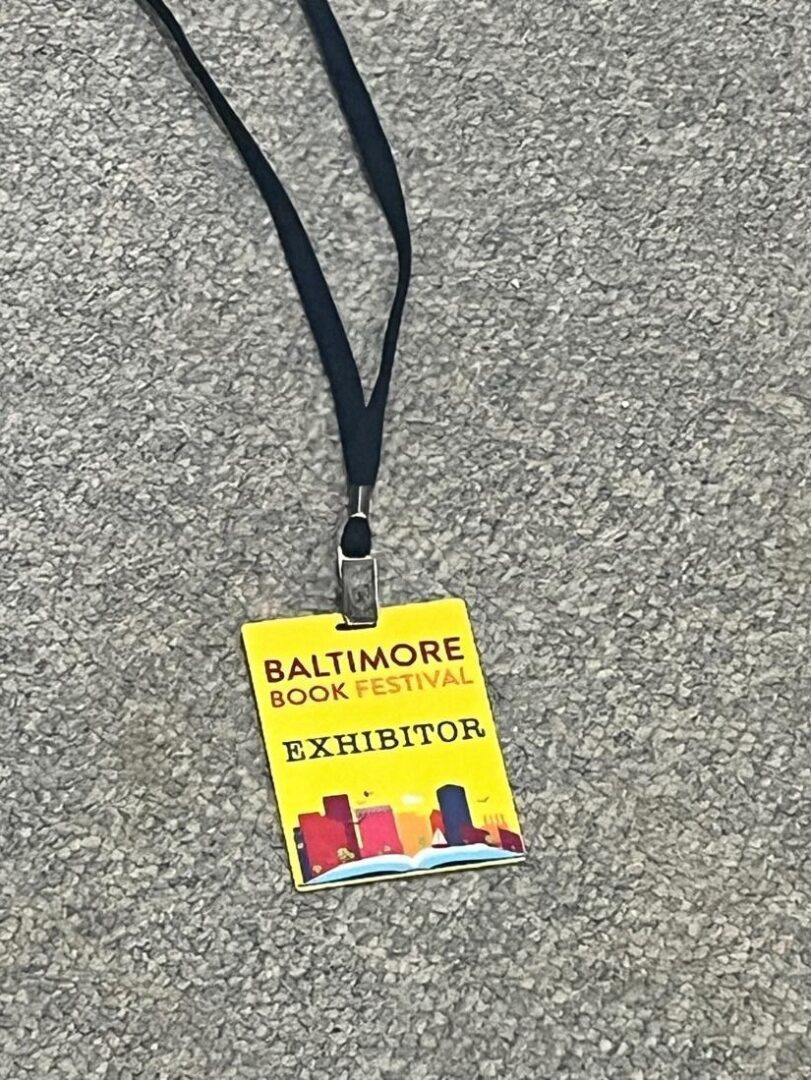
- Sold Books at the Baltimore Book Festival (Exhibitor):
(In 2016, Emre sold books at the Baltimore Book Festival for 3 days).
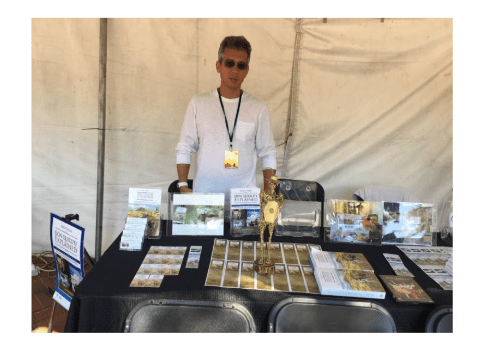
Emre’s Other “Off-the-Radar” Platforms
* Organic Ayn Rand Platforms (That Complement Emre’s Main Platform)
- The Ayn Rand Institute
- The Ayn Rand Society
- The Atlas Society
- The Objectivist Standard Institute
- Ayn Rand Center (UK)
- Ayn Rand Center (Japan)
- Objectivismo (Hispanic World / Brazil)
- Balkan Objectivist Center (Serbia)
Besides having my own platform, I can tap into other strong platforms, with my guest blogging, comments, and sharing. Since, by making excellent insights – and provocative comments – about Ayn Rand and her books, I can step into these online communities, and social networks, fairly easily. Until, I become a reliable, trusted, source. Thereby, enhancing my digital profile by analyzing my subject in ways that will fascinate existing platforms.
*Large Market: 8 major Rand platforms shows editors that:
- There is a large market for Rand’s books;
- There is a large market for books on her books.
* I Can Reach that Market: I can reach that market through my platform, Gavin’s platform, and other Rand platforms.
Writing a Good Book is Not Enough (Authors Must Also be Entrepreneurs):
Emre understands that having great ideas and knowing how to write well, is only half the battle. Since, beyond writing a good book, a writer is also an entrepreneur, who must discover how to economically flourish in this book publishing business.
To this end, Emre is actively researching the industry; to better learn how publishing works.
Indeed, since Emre is a go-getter, self-starter, and self-promoter—who knows his voice and audience very well—he is actively finding ways to generate reasonable sales from his books. Especially, his new one.
Thus, Emre will use his enthusiasm for Rand’s fiction, his passion for writing, and the content of his books, to gradually expand his platform. Until it is better-established, larger, and more active. For Emre is willing to work hard, is invested in his writing career, and is willing to do what it takes to bring his ideas to the attention of more customers.
Indeed, because Emre takes publishing very seriously, has great energy, and singular dedication, he will work hard to increase sales. By doing his part to sell more books.
* He hopes (and expects) you to do the same.
VI. Target Market:
The core message of Emre’s book appeals to several target audiences of potential readers. Besides attracting lovers of Ayn Rand, super fans of her books, and aspiring objectivists—who often use We the Living to understand the roots of Ayn Rand’s Objectivist philosophy—my book also appeals to people interested in Russian life under communism.
Specifically, general readers, who are interested in the human cost of oppressive regimes, political scientists, who want to see a realistic portrayal of the conflict between individual freedom and State control play out in a realistic, fictional, Communist society, and scholars of Soviet history, who will learn a lot from reading Emre’s historical book.
Other potential readers include Ukrainian & Russian Readers, who want to better understand the historical conflict between Ukraine & Russia. Anti-totalitarian readers, who seek human stories that value people’s freedom. Philosophically curious people who are generously receptive to Objectivist ideas. Proponents of individualism, who need to see individual rights expressed through literature. People interested in the everyday impact of political systems on human lives. Western readers, who need to see, in human-and-particular terms, the dehumanizing horrors of living in unfree Soviet Russia contrasted with the benefits of living in a liberal democracy (like America). And, finally, liberal readers who need to see individual rights expressed, in specific terms, through creative literature. Through a realistic depiction of what a human right is and how it applies to people’s everyday lives.
Gurgen’s target audience also includes historical fiction and non-fiction enthusiasts, who want to read a first-hand account of what life in Soviet Russia was like in the 1920’s. Political and philosophical thinkers interested in the moral consequences of Communism vs. Capitalism. Members of the middle class who want to learn about how people like them (the bourgeoise) survived under Communism. And, finally, individualistic readers who need to see people striving to make themselves happy through their own individual agency. Not because of their collective-group-identity; or particular association. But rather, because of who they are, what they can do, and what they want from their lives.
Emre’s book will also appeal to The American Public. Especially, people who want to learn about the contrast between unfree Soviet Russia—where economic collectivism, socialist regimentation, and the destruction of the individual, runs roughshod over the people—and free America—where economic individualism, free-market capitalism, and personal liberality, reigns supreme. Hopefully, after reading about this contrast, Americans will fully appreciate the political system under which they live. Since, in America, people can reach their highest potential and best selves by being who they are, whereas in Soviet Russia, they can’t. Because in America people are free to say and do what they want, practice their own religion, own their own property, earn and retain their own profit, and emigrate abroad. Whereas in Soviet Russia, they could be imprisoned (or worse) for trying to practice any of these basic human rights.
To elaborate, I show all readers—especially American, European, & Western readers—how all people should be free to form their own characters, live their own lives, and say and do what they want with their lives—as long as they do not violate other people’s rights. I do this by showing readers what happens to society when people lack that freedom. When their civil liberties are systematically stripped away by a forceful government like the one pictured in We the Living. How, when that happens, they suffer from political imprisonment, state nationalization, food-lines, eavesdropping, execution, deportation, and all the grisly horrors associated with Communist Russia.
Indeed, Emre wrote Critical Essays to not only show people how dictatorships are created, maintained, and continued—so people avoid voting for tyrants in their own countries—but also to teach Americans how living in a dictatorship chokes people’s lives, by suffocating their spirits, while, conversely, how living in a liberal democracy, like the United States, enables people to live freely. So, they can be true to themselves.
VII. Timeliness (Ukraine & Russia / US Politics / Russian Suppression)
Tagline: “TIMELY – ON SO MANY LEVELS”
Ukraine-Russia War
Emre’s book, is especially timely, given the current war between Ukraine and Russia. Because it examines—in its main body and annotated bibliography—the historical roots of the current war between Ukraine & Russia. Thereby, fully illuminating the base of the current hostilities between these two nations.
Indeed, by analyzing the squalid living conditions of Ukrainian characters, by scrutinizing how Ukrainian peasants are regimented, propagandized and collectivized, at every turn and angle, and by outlining how historically Ukrainian peasants fought against Soviet collectivization, Emre’s book shows readers how Ukrainians (both real and imagined) tried to reclaim administration of village affairs. By retrieving their confiscated tools and cattle, destroying the collective farming system, reintroducing free trade, reopening churches, restoring all goods to Ukrainian farmers, and getting back Ukrainian peasants who were deported.
So, Ukrainians could regain their national independence by abolishing Soviet power in Ukraine.
*Full “Timeliness Statement” (On website & in book’s preface)
https://aynrandanalyzed.com/author-press-kit/
Ukrainian Embassy (Outreach):
Soon, I will write to the Ukrainian embassy, in Washington DC, to explain how my book is a valuable resource to Ukraine and Ukrainians. In this letter, I will explain how the Ukrainian embassy may want to purchase (even translate) my book. Since, it aptly describes (in fiction) the miseries Ukrainians endured under the Soviets.
This missive, will follow-up on my previous diplomatic outreach. By continuing a previous discussion, I already began with the Ukrainian ambassador to the United States, Olga Stefanishyna. Because, during embassy day (May 2nd, 2026) I gave the ambassador a copy of my book, with a few brief comments. In the near future, I will write a concise and formal follow-up letter, in which I will clearly explain how my book is a valuable resource to Ukraine. Since, it directly relates to Ukraine’s mission to remain sovereign and free in the face of unprovoked Russian aggression.
In my letter (and e-mail) I will provide an executive summary, the book itself (through snail-mail), my video book trailer (when ready) and a link to my website. Ending with a polite statement about what I hope the Ukrainian embassy can do for me and my book.
Basically, I want Ukrainians to recommend my book to their citizens (so they better understand why they are fighting). Then, to translate my book (into Ukrainian) for their citizens to read. Afterwhich, I’d like Ukraine’s international affairs office to distribute copies of my book through their cultural channels, which they can order in bulk, at a discount.
Basically, I am trying to build a partnership with the Ukrainian Embassy, so we connect with an rely on each other to mutual advantage.
As part of this outreach effort, I plan to attend social networking events at Washington DC’s Ukraine House, and elsewhere. So, I can build sets of social relationships with Ukrainian influencers. (There are a lot in Washington DC, near where I live).
Attending Ukrainian protests, in the nation’s capital, is another way I can link with potential Ukrainian supporters. Where I can talk to them about Soviet Ukraine, Ukraine’s present war with Russia, and how miserable they were under the Soviets.
If permitted, I’ll also distribute 103 promotional books at these Ukrainian protests and social events. Since, I have many promotional copies (of the first version of my book) to give away. (You have the second edition).
Anyway, hopefully all this socializing will gain me some Ukrainian goodwill. So, that by the time I write to the Ukrainian embassy, I am a known quantity (in certain circles) that Ukrainians feel more comfortable listening to. Because they know I am their ally, who will speak to Ukrainian rights very convincingly. (Instead of just cold contacting the embassy).
Hopefully, an appropriate Ukrainian (maybe the ambassador’s deputy) can introduce me to Ukrainian’s Cultural Attaché. Or, someone else, responsible for buying and distributing books.
Through these efforts, I hope to persuade an important Ukrainian to read my book (at least some of it). So, he (or she) can greenlight a huge purchase order. Perhaps, even Ukrainian translation.
This, may work. Since, Ukrainians are probably one of the only groups brave enough to appreciate and promote my book. Since, they are intrepid enough to embrace my book, even though it is politically incorrect. Regardless of who approves, or disapproves, of its content. Since, I think that Ukrainians are not politically correct cowards—like the biased socialists, prejudiced collectivists, and religionist gate keepers, who have ignored (even renounced) my book. Because it explodes their world view. However, Ukrainians will like and praise my book, for keeping it real. For defending their right to be free. This enthusiasm, in turn, will translate into a huge purchase order, probably in the thousands.
Ukrainian Embassy Outreach (Strategy):
Though, I will write-to the Ukrainian embassy to remind them about my book, I realize that contacting the cultural attaché, or cultural affairs officer, may be more appropriate. Since, this person may be better set-up for book acquisition, translation, and distribution. Thus, I’ll contact both the embassy and the cultural affairs office—very politely and respectfully—to see if we can help each other.
Timeliness (United States Politics Under Donald J. Trump)
Critical Essays on Ayn Rand’s We the Living is also relevant to today’s American headlines. Because it warns against authoritarianism.
Given, that our current president, Donald J. Trump, has authoritarian tendencies, this book is relevant to today’s news cycle. By examining how dictators emerge, how they maintain their power, and what they do to the people they are supposed to lead, once they gain control.
Evidently, Donald Trump is on his way to becoming a dictator—if he is not already one—because he:
1) Imposed tariffs, which is a direct violation of the principle of voluntary trade and a textbook case of the government initiating force against peaceful citizens;
2) Praised authoritarian regimes and threatened journalists for criticizing him — a betrayal of free speech;
3) Proudly appointed religious conservatives to the Supreme Court, ultimately undermining abortion rights — subjecting a woman’s body to the moral code of mystics;
4) Usurped the Congress’s ability to declare war, thereby violating the war powers clause of the US constitution;
5) Empowered masked ICE agents to round-up, even murder, US citizens, searching their homes without warrant;
6) Urged his supporters to storm the US capital on Jan. 6th, 2021, to overturn the legitimate presidential election of Joseph R. Biden. A role that makes him guilty of high treason and a traitor to the nation. Since, he maliciously created and repeated false claims of election fraud. To undermine America’s faith in electoral legitimacy.
7) Spurs political violence to maintain his own power at any cost;
11) Tries to muzzle the free press— or “plug leaks,” as he would say—to hide his activities & silence personal criticism;
12) Governs through emotionalism, not reason — promoting lies, conspiracy theories, and a personality cult that demands loyalty over truth (loyalty tests for civil servants);
13) Attacks Independent Agencies. Trump fires people, dismantles and restructures agencies, and requires people to take orders from the White House.
(Justice Department / Federal Reserve / FBI / Federal Election Commission / Consumer Financial Protection Bureau / Federal Trade Commission / Consumer Product Safety Commission, etc.)
10) Systematically violates human rights, by regularly attacking reason;
11) Substitutes emotional intimidation for argument;
12) Suppresses liberty instead of defending freedom;
Since Donald Trump is an authoritarian autocrat who systematically undermines American civil liberties, Americans need to read this book. To learn what happens to a country when all the power lies in the hands of a single individual. So, they are warned against budding dictators, of every stripe-and-variety, by reading my book. Since, it alerts humanity to the dangers of basically every type of authoritarian regime.
Including Trump’s own brand of a personalist dictatorship, where he handpicks an elite core of loyalists—comprised of family members and close friends—to serve in key posts. Even if they are highly unqualified to serve in these posts. As long as they are loyal to Trump they are appointed to these positions of power, anyway. Because they are mindless yes men who will do whatever Trump wants.
Further, personalist dictators, like Trump, purposefully segment society, so different groups cannot unite against the dictator. This, he accomplishes, by closely monitoring and controlling his political appointees. So, they do what he says, instead of coordinating and collaborating with each other.
For Trump strictly stage-manages his subordinates’ political roles. Since, he wants to concentrate all power in his person, so he can control everything from the center. So, he can exercise dominance over society, by controlling key political positions, the government’s treasury, and people residing within the United States. Further, like all personalist dictators, Trump distrusts the intelligentsia greatly. Since, the intelligentsia can think, question, and challenge, whereas Trump wants to be obeyed, feared, and revered.
In sum, personalist dictators, like Trump, are different than other dictators. Since, personalist dictators favor loyalty over competence, distrust intellectuals greatly, and use people to get what they want, at any cost. Regardless of the consequences to these people’s lives.
* Emre’s We the Living book fully defines what a personalist dictatorship is (Footnote 219; page 242).
Sam Harris & Jonathan Roche also recorded a video about how Trump is a personalist (fascist) dictator.
https://www.reddit.com/r/samharris/comments/1qw38kp/yes_its_fascism_sam_harris/
* I hyperlinked this video, to not only enhance my credibility—so you believe me more—but also to further clarify how Trump’s authoritarian government resembles the Soviet dictatorship that Emre’s book so aptly describes.
https://www.youtube.com/watch?v=ARAhCmK0eCE&t=1407s
A video about Trump corrupting the Republican party (GOP)
Timeliness (Russia Becoming like the Soviet Union)

Since, modern-day Russia and Soviet Russia are becoming virtually identical, readers may enjoy reading a book that makes these connections clear. That shows readers realistic parallels between history’s Soviet Empire and today’s Russian Federation. For today’s Russian Federation—despite lacking the official Communist ideology of Soviet times—still shows increasing similarities to Soviet Russia. Through authoritarian centralization, the suppression of political descent, state control over the media, and a security-driven, anti-Western, foreign policy.
Sadly, Soviet history is repeating itself, in a modern Russian context. Since, Putin’s Russia and Soviet Russia are becoming similar (even identical) in many ways.
To make these connections clear, I’ve listed (below) several significant parallels between We the Living’s Soviet Russia and Putin’s Russian Federation.
Remarkable similarities that my book mostly suggests— sometimes by direct reference but mostly by inference and allusion—leaving it up to astute readers to fully see for themselves. To completely learn how Russians are now being repressed in basically the same ways that We the Living’s characters—and therefore real Russians—were being repressed before. Under the Soviets. Through severe control mechanisms reminiscent of the soviet-era.
To make these parallels clear, I have listed (below) how the book’s characters are stifled under the Soviets in many of the same ways that Russians are now being repressed under Putin.
Mainly, through:
1) Brain Drain (The Best Leave):
(In Soviet Russia there was a severe brain-drain after the Communist revolution when many skilled professionals left the country. This massive exodus is shown in “We the Living,” when several characters leave Russia. Mainly at the start of the revolution, before Russia’s gates slammed shut, seemingly forever. A transitional time, when many of the novel’s educated citizens, scientists, and entrepreneurs emigrate to foreign lands while they still can.
Now, the same thing is happening again. History is repeating itself. IT professionals, scientists, journalists, and entrepreneurs, are all leaving Russia, once again, in droves. To avoid being drafted. Thereby, severely diminishing Russian technology, finance, and research, for decades)
2) Food Scarcity (Empty Shelves):
(Once again, people face exorbitant costs, at private grocery stores, which have empty shelves. Sometimes, they even wait in food-lines, as they did before, in Communist Russia)
3) Hyperinflation (Rubles Devalued):
(Again, this is happening. Since, the start of the war with Ukraine (February 2022) the Russian Ruble is down 27 percent (from its pre-war value) which translates to 270 percent inflation. Thus, you would have to have to pay 270 times more Rubles to maintain the same purchasing power. Recent reports also show that Russia’s economy continues to weaken. This, like in “We the Living,” is because of unrestrained State spending in the form of military-industrial production. With nearly 40 percent of the government’s budget allocated to national defense)
4) Nationalization (People’s Money Seized):
(Funds are once again being seized by the Russian State—from Russian citizens, foreign firms, and oligarchs—just as funds were extorted from all these groups in “We the Living.” When the GPU seizes their houses, bank accounts, safety deposit boxes, and chattel. Thus, Russian’s private property is being stolen once again, by a criminal state, just as it was, in “We the Living”)
5) Human Rights Violations (Protecting Russians Against Foreign Spies):
(Like in “We the Living,” Putin’s Russia is full of rhetoric about how Russian’s are being rounded-up, enjailed, and possibly executed, to protect Russia against Western spies. As before, this accusation is just a pretext to legitimize the State’s elimination of its’ opponents)
6) Corruption and Bribery (Bribes Needed for Mostly Everything):
(Since, Putin, and his inner-circle, have stolen hundreds-of- trillions of Rubles from Russians (by taking huge bribes) what most Russians do nowadays—especially in politics & the military—is (sadly) normal. Since, bribery – both in modern Russia and in “We the Living’s” Soviet Russia – is common)
7) Military Buildup (Russia’s Military & Industry):
(Again, Russia’s military-industrial complex is being rapidly expanded. Because now Russia’s military spending is 40 % of Russia’s entire GDP, while Russia’s industrial output rises by 2.3 percent a year. This steady growth is heavily skewed toward defense and military production while civilian manufacturing and consumer sectors are (once-again) stagnating and declining. Basically, Russia is reverting to a Soviet era security state once again; a nation where citizens have virtually no rights)
8) Military Purges (Sergey Shoigu and Company):
(Like Andrei Taganov, of the GPU, and Stephan Timoshenko, of the Russian Navy, are purged from the party because they have a conscience, Russia’s former defense minister, Sergey Shoigu, is also being removed from office; from the Kremlin’s inner circle-of-trust. By first being demoted to a position with no power—despite its impressive sounding title (the Secretary of the Security Council)—then, later, by being kicked out of the army, entirely.
(Maybe, Shoigu won’t be fired, because his skills and knowledge are needed—because he is an economic technocrat Putin needs to build a war-time economy. But when Shoigu is no longer useful, he will probably be gotten rid of, in one way or another. Because Putin feels threatened by Shoigu. Since, Shoigu is an alternative power center that may eventually challenge Putin’s leadership).
Anyway, like military leaders are purged in “We the Living,” Putin also purges potential competitors who are getting too powerful. People, like Sergey Shoigu, who may object to Putin’s policies, because they have minds-and-wills of their own)
9) Information Control (State Media Dominance):
(State media dominance & legal repression of independent journalism exists in “We the Living,” and now exists again in modern-day Russia. Since, both versions of Russia create dis-information bubbles of State propaganda, through newspapers, radio shows, and more. Thus, effectively trapping today’s Russian citizens under the systematic censorship of a Soviet style dictatorship reminiscent of Soviet times. Reminiscent of “We the Living.”)
10) Erosion of Truth, Accountability, and Institutional Checks (No Outside Checks):
(The parallels between “We the Living’s” Soviet Union and Russia’s current stagnation show readers what happens when institutions serve power instead of truth)
In conclusion, although Emre’s book examines all they ways that Russians were controlled and oppressed under the Soviet Empire—especially in the context of We the Living—and although Emre’s book alludes to some modern-day Russian similarities—by offering incontrovertible evidence of modern-day suppression—sometimes Gurgen’s book only suggests, or infers, this connection. Leaving it up to active readers to connect the dots. To see all the ways that modern Russia is becoming like Soviet Russia.
* Parallels between Soviet Russia & Putin’s Russia, are linked above.
Timeliness (Communists, like Zoran Mamdani & Hasan Piker are Mainstreamed by the Democratic Party)
1) Timely (Communism in US Politics and Society [Zoran Mamdani & Hasan Piker]):
Speaks to Marxist political developments happening in America. By inferring that the thinking of neo-Marxists, like Zoran Mamdani, who was elected to be NYC’s mayor, strongly resembles the thinking of We the Living’s Soviet officials. Who also believe, like Mamdani does, in the abolition of private property rights, a ban on all guns, a state-wide housing guarantee, the implementation of State guided socialism, and the elimination of free-market capitalism. Such a strong connection between what Soviet politicians promise in We the Living and what is being called for now, by American politicians, is really alarming.
Since, we have already seen, in Rand’s fiction – and in reality – how society is destroyed when people are expected to live for the State & others (not themselves). How society basically collapses, when Socialists (like Zoran Mamdani) get their way, for any extended period of time.
(* See for yourself)
https://www.foxnews.com/video/6387299706112 (Mamdani’s Aide)
Recent social developments in the US spawned by another socialist figure named Hasan Piker, are also worrisome. Akin to We the Living’s reporters, Hasan Piker is a Marxist intellectual who also calls for State socialism.
Recently, he has been main-streamed by the democratic party. By Ezra Klein, a leftist journalist and podcast host, who recently wrote a conciliatory NY Times column calling for Democrats to embrace Piker; to give him a platform; to bring him under the wide tent of the democratic party. Ultimately, platforming Piker, by enabling him to be interviewed by the New York Times, and podcasted by The New Yorker.
To me, just like We the Living’s Marxist intellectuals are a great danger to human freedom and flourishing, so is Hasan Piker 4. Since, like the book’s Communist leaders, he is also a danger to civilization. Because he supports the same (or similar) social policies. Social policies that turn the book’s characters into nation-wide poor house, where people are mean and barbaric.
4 I, for one, don’t want Hasan Piker—and his Marxist banter—infecting the American public like “the woke mind virus.” Rather, I want principled democrats to continue to shun this man, like they did before. Not engage with him, as called for.
So, if you want to learn how the policies of socialist figures – like Piker – ruin people’s lives, please read my book. Since it shows readers, in the context of We the Living, how Piker like socialist policies, ultimately distort society. By turning people into monsters deformed by State socialism.
https://www.youtube.com/watch?v=fFbZX9LeTzI
(Hasan Piker’s Video on Communism)
https://www.youtube.com/watch?v=WdRFiOH7ioM
(Hasan Piker is the Left’s Nick Fuentes by Sam Harris)
VIII. Synopsis
Essay 1: How Communism Destroys People’s Lives in Ayn Rand’s We the Living (50, 003 words)
Summary:
My opening essay analyzes how the book’s Soviet regime ruins the lives of We the Living’s characters in 50 ways. But, to save space, I will narrate just 5 of them.
One, Communists break characters’ lives by nationalizing their homes, stores, businesses, and bank accounts, then centralizing all large social supplies and provisions. Like food, housing, medical care, and higher education, which are all concentrated and distributed by state agencies.
Second, Marxists waste characters time – and damage their health – by making Russians queue-up in endless lines for barely edible food—mildewed millet, moldy flour, rancid sunflower seed oil, powdered eggs, rotten cabbage, dried herring, acorn coffee, coffee-ground pancakes, and crusty bread—in front of state agencies, communal kitchens, state co-operatives, and other provision centers. Where characters are forced to trade their ration cards for incredibly low-quality food that is always in short supply. As they wait in long lines, even on Saturdays, for the thin trickle of life that still drips from provision centers.
Third, the regime destroys people’s working lives by forcing characters to partake in State sponsored social activities for no pay, otherwise they are fired for disloyalty.
Besides subjecting characters to the dreaded reduction-of-staffs system, the fourth way the novel’s government destroys Russia’s social fabric is by replacing the bonds of family love with the ties of State loyalty. By forcing Russian parents to turn over their children to Soviet youth groups, like the Young Pioneers, for example, or the Teenage Komsomol, for instance. Thereby, brainwashing the next generation of robotic young revolutionaries. By not only forcing them to conduct physical cultural drills—singing, marching and playing drums—but also by distributing and discussing Soviet propaganda with them too.
The fifth way the book’s Soviet regime wrecks characters lives is by violating their privacy rights, even in their own homes, which they do by constantly moving strangers into people’s private flats. Designating that an Upravdom (a Soviet building manager) not only dictate to Soviet citizens how much square footage they are allowed to live in but a state official who continually enforces the State’s Domicile Norm, which stipulates that any apartment above the proscribed square footage will immediately have more people moved into it. Because its square footage is greater than the maximum allowed by law. Further, if characters find housing, the flats people move into often have no heat, no electricity, no water, no air conditioning, no telephones, burst water pipes, and leaky rooves.
* Other Topics (Essay 1):
To save space-and-time, I have bullet-pointed many other points my first essay makes. To show you how comprehensive it is. So, you better understand the scope, depth, and value of my 1st essay. Thus, the below topics-list, summarizes most of my 1st essay’s remaining topics. Such as:
- How the book’s different modes of transportation—trains, trams, cabs, sleds—cause gruesome accidents & long delays;
- How the novel’s Soviets try to turn Russians into new men;
- How Soviet peasant characters, especially hypothetical Ukrainians, protest the seizure of their crops by first locking Soviets inside their village barns. Then burning down those barns, with Soviet officials locked inside, singing peasant hymns to drown out their death screams;
- How the book’s Soviets cause a wide-variety of diseases in the story (typhus, scurvy, glanders, and tuberculosis) by dirtying Russia’s cities-and-countryside. Then using a tarry carcinogen named Carbolic Acid to sanitize these diseases. Sadly, this chemical disinfectant also kills characters, too. By giving them cancer;
- How the novel’s GPU requires travel permits, militia registration, and local taxes to be paid, for internal Russian travel. To suppress characters freedom of movement and residence. Not only in regard to travelling from the city to the country (and vice versa) but also to ensure that characters live where the government tells them to (closed vs open cities);
- How the novel prepares characters to accept communism into their lives. By installing propaganda posters, State banners, and red slogans, all over Leningrad, depicting the glories of Russians who believe in, and act for, a collective workers paradise;
- How We the Living’s propaganda department further brainwashes characters at school by making them study (and create scrapbooks) of Lenin;
- How We the Living’s Communist state further propagandizes characters through Soviet cinema. By creating films that portray life to be happy & good in Soviet Russia, even though it was hopeless and doomed. Also, by staging Red ballets, such as The Dance of the Toilers, where fragile ballerinas wear papier-machete chains on their thin arms-and-legs—to symbolize their unlimited toil and absolute State submission;
- How an orphan from a Soviet reformatory named Sasha Chernova, fights to improve the novel’s terrible working conditions by spurring workers to overthrow the Soviet government at their factories;
- How, because the book’s Soviet government views private property as evil, they deliberately inflate characters rubles. Until, they are forced to sell (or trade) their family heirlooms for basic living materials, such as food, kerosene, and industrial goods;
- How We the Living’s Soviet government disabuses land-hungry peasants of the foolish notion that the land is theirs; that the land belongs to the people who till it. Since, it doesn’t. Rather, peasants feel cheated and tricked when they learn that the Soviet Revolution does not provide peasants with their own land to cultivate, as promised. But rather that all land belongs to the state;
- How the novel’s peasants are arrested or deported for having taken part in commerce. For having sold their grain on the open market. For farmers harvests are stolen by Soviet requisitioning detachments, especially if they discover that rather than fulfilling State agricultural quotas farmers try to sell their grain on the open market;
- How requisitioning brigades steal peasant’s food to build up Soviet industry on their bones. Which, ultimately, causes the book’s peasants to hide, or steal back, part of their harvest every night;
- How the book’s peasants “burn the local Karl Marx club [in the] Vasilkino, Svershkoe, and Petrovshino, [villages], assassinate twenty-six party members in outlying village districts, [raze] eight [communist] clubhouses, three [red] schools and [one] communal farm storehouse” (377, 378, 407). So, they can reclaim local administration of village affairs;
- How the presence of an anarchist revolutionary named Nester Makhno—during a train ride from Crimea to Saint Petersburg—shows readers how Russia’s underground criminal networks also hated the Soviets. For Makhno, and his supports, the Makhnovists, called for the end of violent requisitioning of peasant food, the elimination of heavy peasant taxes, and the expulsion of brigades who were assigned to take peasant possessions. Accordingly, the Makhnovists banditry was directed against the government and officialdom rather than against Russian citizens;
- How a GPU officer named Andrei Taganov uses his party card as a butcher’s knife. By executing crowds of thousands of starving peasants who besiege the barns where their stolen food is held. Where food detachments had stored the grain that had been taken from them. As a temporary staging point to transport that grain to urban areas and the army;
- How this same GPU officer, Andrei Taganov, turns on communism. When he realizes that Marxism does not value human life. For Andrei is a tragic example of a man who is broken by the realization of what believing in Marxism really means. Since, after learning from Kira, that the individual is worthless before the state, Andrei questions and judges his Party. Then, after gathering sufficient evidence of Communism’s evil and his massive error, he breaks with Marxism;
- How the book’s apartment buildings often collapse, without warning, all over the city, due to lack of Soviet upkeep. Since, houses in Saint Petersburg long in need of repair, crumble into a pile of dusted rubble. Horrifying workers when they return home from a long day of toiling for the state. Since, when they get home they see that their homes, together with their private property in them—which they worked hard to accumulate over a long time—vanishes in an instant;
- How the book’s communist government makes characters trade their coupons for food, manufactured goods, and other items, they do not need, and do not want. (Like when Lydia takes soap and herring at a university co-operative even though she does not need these products);
- How the novel’s Soviet Union exposes characters to diseases—typhus, scurvy, glanders, and tuberculosis—because they can’t keep their country clean. Causing characters to rub carnation oil, even kerosene, on their heads, bodies, and clothes, to ward away disease carrying lice;
- How characters have to cope with lousy Soviet manufactured goods. Such as kerosene stoves that explode, matches that don’t light, shoes with cardboard soles, dim lightbulbs that burn out quickly, handkerchiefs that tear easily, clothes with missing sleeves, loose handles that fall off pots, and foreign objects baked into loaves of bread;
- How the book’s Soviet government damages people health by making them stand in endless lines during deep winter. Where they are exposed to strong winds, freezing ice, blinding snow, cold sleet, driven rain, and large hail, in front of communal kitchens, university co-operatives, state offices, state hospitals, and other provision centers, in all-weather winter conditions. Waiting in lines that stretch around the corner. As the queue-up for hours, days even, waiting for their meager rations. Contracting frost bit, open sores, respiratory infections, joint pain, dry skin, sore throats, colds & flues, while they wait;
- How the novel’s Soviet minders eliminate characters freedom of movement. Until, they can’t live, and travel, where they want. Instead, characters need to furnish travel permits on train rides, and secure permission, from multiple authorities, for any overnight stay, anywhere. (Especially, stays over 48 hours).For example, when the Argounova’s take a train from Crimea to Saint Petersburg, GPU agents kick open their train doors, several times night. Sternly ordering them to hand over their “travel documents.” Similarly, when Leo and Kira try to travel to a beach, they need to register their stay with the local militia department, and pay local taxes, to obtain permits as transient guests. Just to get permission for a one-night stay at a nearby beach town.We are also told that part of the reason why the authorities restrict characters ability to live and travel where they want, was “to limit the rural exodus of starving Ukrainian peasants who were fleeing from the countryside to the cities in search of food.”
- How the book Soviet State banishes university students and alleged counterrevolutionaries to Siberia. (Like, Sasha, Irina, and other anonymous university students). Where 9 out of 10 prisoners, like them, die within a year of being imprisoned. Due to overwork, starvation, freezing, hunger, lack of medical attention, slow mistreatment, and treatable diseases (scurvy & ulcers). Since, when imprisoned, most prisoners undertake huge projects for the state that can only be carried out by penal labor. Projects like dam building, railway construction, bridge and road building, coal mining, and petroleum extraction.
- How characters wages are automatically garnished (without their knowledge) for social insurance; membership dues for the Proletarian Society of Chemical Defense; taxes for Russia’s Red Air Fleet; and taxes to liquidate illiteracy.
- How the book’s office managers will not hire the bourgeoise. Since, they remember that “when they had been jobless in the old days their bourgeoise brothers would not hire them.” Thus, to get revenge, these hiring managers tell hopeful job seekers, like Leo, that “No. They have no job opening. And none are expected.” They say this because they think “it will do bourgeoise people good to learn how it feels” to not be hired.Thus, the cruel refusal of even the right to make a living for characters with an aristocratic past shows readers how strongly former aristocrats are discriminated against. Ultimately, suffering from a frightful lack of work, simply because they are high-born;
- How the book’s Soviet officials conduct nationwide purges of universities—like the Technological Institute, for example, or the Petrograd State University, for instance, or the Art Academy, case in point—by inventing purge questionnaires, which they distribute in schools and at work, asking Russians: if they are party members; if they are in a trade union; what their job is; what their parents background is; what they did before, during, and after the revolution? If these people where once wealthy, or highborn, or suspected of having the wrong social origins, they are gleefully tossed out of their studies and jobs, during the Great Purge of 1936;
- How the book’s Soviet State purges Communist party members who had been in the party well before the 1917 revolution. Party members, like Stephan Timoshenko, Andrei Taganov, and Leon Trotsky, who dare to say that the Party has betrayed the principles of the original Marxist revolution. Thus, for whistleblowing, these revolutionaries are kicked as traitors. For standing on principle. For telling Soviet officials that “they’ve lost the battle, strangled the revolution, sold out the people, for power, brute power.” For saying, like Leon Trotsky did, that Russia has become “a degenerate workers state controlled by an undemocratic bureaucracy,” which would eventually be overthrown by another political revolution; by a representative “worker’s democracy.” And, from then on, “all decisions would be made democratically, according to workers principles of socialism;”
- How party members also feel that Communism has deceived them. Because though they “joined the party to make a better world for poor, forlorn, people,” the positive changes promised to them by the original revolution are being betrayed. Since, the real beneficiaries of the revolution are not ordinary, everyday, characters like Stephan Timoshenko and Andrei Taganov. But, instead are cruel Soviet politicians, corrupt merchants, and other governmental minders, who betrayed the revolution in the name of enforcing it. Men, like Pavel Syerov, Karp Morozov, and Victor Dunaev;
- How We the Living suggests the Soviet practice of slaughtering its own Red Army by placing a second secret police army behind it that would fire forward so nobody could move back. The novel suggests this by recounting two famous Russian land battles—the Battle of Petrovshino and the Battle of Samsonova—where thousands of Russian soldiers were also gunned down mercilessly by the people behind them. By Stalin’s own personal army that would rip the dog tags of off slain Russian troops. So, Russian’s did not know that their own troops were being murdered by their own soldiers;
- How the book’s State Textile Trust makes clothes for characters. Like 3 dresses, with 6 print patterns, every poor woman who wants new State clothes must wear. Ultimately, making women – like Kira and Irina – lose all joy in their new garments, since they wear similar (or identical) dresses that thousands of other women already have. Making women feel like inmates of a huge orphanage, or asylum, because they all look the same;
- How the novel’s government tears down symbols of a culture, faith, or belief, opposed to its own collectivist ideology. To this end, hundreds of the novel’s “churches are [either] destroyed,” or allowed to go into a state of collapse, since Christians believe in the sanctity of an individual’s soul. “Greek statues [are] destroyed” because Pagans believe in individual heroism, especially on the battlefield. Aristocratic “coats-of-arms” are ripped off their hinges and burned to ash because lords in an aristocracy respect their citizens individuality. The Czar’s “imperial eagle,” is removed from in front of his opera box at the “Mikhailovsky Theatre” because the Czars were much more tolerant of individual initiative;
- How the novels closure of churches, mosques, and synagogues causes Christians, Moslems, and Jews, to be mocked and mangled. This also causes a deeply Christian character named Lydia Argounova to call the Soviets “sacrilegious apostates [who will all] burn in hell [because] they defy God!” Because they’ve “opened the sacred relics [to take] gold ikons,” religious heirlooms, and other historical treasures, from churches. Including church bells that are melted down for scrap metal, since Communists claim that the sound of bells ringing on Sundays disturbs the peace of atheists;
- How characters are injured, maimed, or killed by dangerous transportation. For example, an anonymous peasant woman is decapitated when she falls asleep at night riding a train. Since, when sleeping, she slides off the hitch (or buffer) in-between cars, is pulled under the train, and is dragged, for a few minutes. Until her head is cut off. Similarly, a man named Mitya Vessiolkin cuts off one of his hands, when he tries to jump onto a moving tramway. Likewise, another man named Boris Koulikov “cuts off both of his legs, [when he] tries to jump into a tramway moving at full speed.” Kira, almost dies, twice. Once, when she is almost grinded off of a tram platform, by a passing truck. And, again, when she tries to leap onto Leo’s departing train, just as it is about to go into a tunnel. Evidently, Soviet citizens resort to these desperate measures to not only avoid waiting for weeks for a train to appear, but also because there are “no reliable schedules and time tables,” with the Soviets in charge;
- How the book’s Russian government drives characters, like Leo Kovalensky, to be black-market food speculators. Since, they not only fire him from translating Russian books into English, French, and German but also because he refuses to teach English to Russian sailors of the Red Baltic Fleet, at nights, for no pay. How, though, after being fired, Leo clears bricks from collapsed houses, clears snow from the city’s streets, and constructs the pillars of a bridge, eventually even these low-level jobs dry up. So, because Leo is sick-and-tired of facing bared door after barred door when he looks for work—with the same response; no opening, no job, no work—eventually, Leo sells stolen State food to scores of shops all-across Russia. For all Leo cares about is giving himself and his girlfriend Kira a taste of wealth before he dies: “ ‘So they shoot food speculators? Why don’t they give us a chance at something else?’ ”;
- How bribery, extortion, and corruption are common practices in We the Living. Since, Alexander bribes an apartment manager for housing; Kira bribes an Upravdom to get a tenant kicked out of her house; Karp Morozov bribes a Russian for space to run a black-market food store; and, a hiring manger asks Leo for a bribe in exchange for a translation job. Evidently, bribery, extortion, and Vzyatka, become everyday practices in We the Living. Since, survival, under Communism, requires lawbreaking. This is also why the novel’s Marxists steal State food from the State railway station—then sell it in an illegal food store—while high Soviet officials, like Pavel Syerov, escape punishment for their involvement;
- How We the Living’s government muzzles the free press. By not only shutting down all non-Bolshevik newspapers but also by creating a placard newspaper know as The Wall Newspaper. This newspaper, which is posted on the wall of every workplace, faults, or praises, characters for their social (or anti-social) behavior. Since, this Wall Newspaper is the voice of social activity that gives constructive proletarian criticism on character’s social behavior. Awarding social credits for State approved behavior, and social demerits, for un-Marxism like conduct. (A high score leads to job security, at least for a while, while a low score gets characters fired);
- How State informers vigilantly spy-on characters. So, they can trade information to the government for some type of reward. (Like more food, better treatment, or the permission to live alone, for example). So, to gather this data, citizen informants watch characters intently. Hoping to raise State alarm bells for their questionable wealth, doubtful conversations, and unusual actions. Often, denouncing characters, simply for having a bourgeoise bearing and attitude;
- And, lastly, how the novel’s characters have no right to face an objective justice system, based on objective rules, and rational procedures. Instead, characters are subject to courts of class justice, where social revenge becomes the order of the day;
* Incomplete synopsis. Learn more, by reading Emre’s book.
Essay 2: How We the Living’s Soviet State Compels People to Work for Their Collectivized Government through Forced Social Activities (37, 918 words)
Summary:
My second essay shows readers how the book’s Communist government forces characters to support the official Leninist Party line—regardless of their actual evaluation of Communism—so they can advance in the Soviets new red world. Ultimately, “wasting their time on stupid, hypocritical social activities [where they] humiliate themselves by playing up to the Red authorities” (Rand). By engaging in communal work programs, after-hours night classes—to teach illiterates—by managing club libraries, drawing propaganda posters, memorizing newspaper statistics, editing Soviet newspapers—like The Wall Newspaper—and by volunteering for the Marxist Circle. Similarly, characters are also expected to deliver lectures for the Komsomol, teach citizens about the responsible management of State food at the State Food Trust’s Educational Circle, and by partaking in various State marches, like a parade to honor a British Trade Unions, for example, or a procession to commemorate Andrei’s solemn state funeral, for instance.
If characters refuse to participate in these voluntary, after-hours, activities—as a mandatory State duty—they are fired from their jobs, for not properly supporting the Soviet Government. During a dreaded “reduction-of-staffs” clearinghouse procedure, which periodically purges employees who are not sufficiently loyal to—and enthusiastic for—the Soviet government. Thus, characters who refuse to donate their leisure time to the Soviet State (for free) are listed as unemployed bourgeoise. Because of which they are stripped of their food rations (their food cards are taken away); they are forced to shovel snow (in their old age); they are taxed much more than Soviet employees (for everything); and have to pay much more for apartment repairs, as well.
So, to ally their overwhelming fears: fear of starvation; fear of being suspected of disloyalty to the regime; fear of being informed upon; fear of being summoned by the GPU; people, like Alexander Argounova, take low-level Soviet jobs. So, they can get bread cards, lard, and sugar, which food rations they so desperately need. To feed themselves and their starving families. Thus, because Alexander works as a low-level Soviet book keeper on the Vasilevskiy island, he is now listed as a Soviet employee by his Upravdom. So, now he is entitled to State food rations. Because, now, Alexander is a Soviet employee who is no-longer suspected of being bourgeoise.
Another theme my second essay examines is how We the Living’s Soviet Union forces characters to focus on their immediate survival needs—not a long-range plan for their lives—by glorifying everyday Soviet toil. Until characters are unable to create a plan for their lives apart from party ideology and communal activity.
Thus, to ensure that Russians are busy focusing on their immediate survival needs—not on overthrowing the government—the book’s Socialist government clogs their citizen’s days with many different social activities. Activities that render characters far less likely to foment a counter-revolutionary rebellion. Since, the State not only keeps them busy with endless volunteer work but also feeds them mush, so they do not have the physical energy to attack the state. For it is a matter of self-protection for the party to force everyone to be totally absorbed with their daily survival efforts. By providing only a scintilla of food to keep their citizens barely alive.
My second essay also examines how We the Living’s collective government tries to forbid citizens from loving – and marrying – the petty bourgeoise. Counseling Russia to break off lovely romances with bourgeoise men and women by publishing magazine interviews that advise Russians that “true proletarians do not marry out of their class.” For the book’s collectivist government thinks that “individual love is a bourgeoise prejudice” that decreases the toiling masses overall devotion to the Soviet government. Accordingly, the novel’s characters, like Andrei Taganov, think that their love for bourgeoise people, like Kira Argounova, is somehow sullied, unclean, and shameful, when it is not. Thus, subjecting love (just like everything else) to the gray rot of Soviet dogma.
Further, my second essay explores how representatives of a dying old world—Alexander, Vasili, and Galina—are compelled to sever their ties to the Russian upper classes and to Orthodox religion. To adjust themselves to a new red culture typified by party activity and revolutionary ideology. By contrast, I also examine how the Argounova brothers refuse to turn over their life and work to the Soviet government. Since, these two brothers (Alexander & Vasili) do not want Russia’s government to take over and corrupt their identities at the workplace. Because they know full-well the lurking dangers of associating with dehumanized Marxists.
My second essay also examines how Stalin’s New Economic Policy (NEP) was a temporary economic liberalization of Soviet Russia, begrudgingly adopted by the authorities, to make it easier for Russians to get food and manufactured goods. Since, even Soviet leaders are not immune from public opinion, especially if voiced by millions of Russians. So, to grant their citizens a slight reprieve from hardship & struggle, Stalin implemented the NEP in 1921. However, in the novel, we see how hypocritical the NEP is. Since, characters who represent the NEP, like a tricky merchant named Karp Morozov, grow rich by bribing officials, stealing food, and minting money for Soviet officials, such as Pavel Syerov.
Conversely, Russia’s NEP suppresses honest businessmen, like Alexander Argounova, by raising their taxes, soliciting bribes, and make them default on their loans, until they cannot compete with successful merchants under the NEP. Because they use pull, influence, and favor giving (blat) to navigate everyday life. Since, corrupt merchants who create a money-making machine for Soviet officials, like Karp Morozov, are allowed to operate, indefinitely. Not for any moral or ideological reason. But simply because they put more-and-more money into the wallets of crooked Soviet officials.
My second essay also examines how We the Living’s Marxist State features painting, photographs, statues, and busts, of Communist leaders, in gigantic size. Because in a collectivist dictatorship loving the chief is like loving the regime. So, to foster this total State loyalty, the book’s Soviet government displays prominent images of Karl Marx, Vladimir Lenin, Frederic Engels, Gregory Zinoviev, and Anatoly Lunacharsky. Ultimately, placing their images in State offices, at job centers, at various open air markets—like the Alexandrovsky Market, for example, or the Kouznetzky Market, for instance—as well as in booths, kiosks, and makeshift stores, located on various streets, alleys, and promenades. To advertise for the regime. To assert the regime’s power. To shape a positive image for the regime that molds popular opinion in the dictator’s favor.
This essay also shows readers how a woman named Comrade Sonia “represents mob womanhood at its most dangerous,” since she wants to bring new life to men out of the ruins of students broken lives. For Comrade Sonia is the new Soviet woman of a new day, who controls most of St. Petersburg’s other women. Because she has 5 women’s clubs, 2 profunions, and the Zhenotdel—a section of the Communist Party dedicated to women’s affairs—under her thumb. Ultimately, prompting students, like Kira, to promote State Marxism by joining Marxist Clubs, Red Student Councils, and other forms of State power.
However, my second essay also shows readers how Comrade Sonia made a big mistake by trying to convince Kira that her highest loyalty should be to the group, not to herself. Since, Kira attends Petrograd’s Technological Institute to choose a profession that will make her happy because it answers the call of her own selfish-greatness. So, she chooses architecture, since it is the only profession for which she does not have to become a licensed state liar. Since, steel-is-steel.
Lastly, my second essay explores how We the Living's Soviet State creates satirical cartoons that lampoon Western figures who do not embrace Communism. Figures, like Neville Chamberlin, who opposed many Communist policies. Policies like nationalizing industries; overspending on social programs; increasing the power of trade unions, and more.
Evidently, since the novel’s Communist newspapers hate Chamberlin’s stances on their favorite pet projects, they mock him in print. Even though Chamberlin was in favor of many social policies that Russian Marxists should have supported. Policies like limiting the working hours of women and children laboring in factories; mandating that employers provide at least one week of paid vacation per year; and establishing a national system of unemployment benefits were workers receive temporary monies for their living expenses—food, clothing, and shelter—while they are laid-off and looking for work. Yet, because the novel’s Red State does not want to expose their citizens to classically liberal ideas that could cause workers to riot, they depict a steak-eating Neville Chamberlin “crushing the British proletariat,” by sitting on a “red-bloused” worker with his chair (196).
Ultimately, this ludicrous juxtaposition shows readers the hypocrisy, the double standards, and the systematic lies of the novel’s Soviet regime.
* Incomplete synopsis. Learn more, by reading Emre’s book.
Essay 3: The Longing of all Things Foreign in Ayn Rand’s We the Living: How Characters Want to Emigrate Abroad to Win Their Civil Freedom (27, 610)
Summary:
My third essay shows readers how Russia’s most intelligent, most moral, most able citizens (the nations top 10 percent) try to flee to a freer West. To nations like Germany, Latvia, Azerbaijan, and Moldova. So, characters can live for themselves, under classically liberal governments that leave people free to determine their own thoughts, beliefs, and action, for themselves. Without a Soviet government always telling Russians where they should live, what they should read, what they should write, what they should say, how they should think, and, basically, what they should be.
This, ultimately, is why characters, like Kira Argounova, Leo Kovalensky, Andrei Taganov (and others) either try to escape, secretly-and-hurriedly, in the middle-of-the-night, abroad a secret smugglers ships (Kira & Andrei) or think about defecting to Germany by being assigned to a foreign post in a Western country from which they will defect (Andrei & Kira); or try to escape, on foot, over the Latvian border (Kira); or try to leave Russia by taking a train to Baku, Azerbaijan (Irina & Sasha).
So, characters desperately flee Russia, in any way they can, since they want to live in a nation that is free from political imprisonment, slave labor camps, firing squads, mass-murder, food shortages, clothing shortages, endless lines, poor housing, phony trials, man-made famines, torture, the persecution of professional intellectuals and the clergy, together with the mind-numbing drudgery of their dreary existences. So, they can escape the gloomy hardships of their dead-end Soviet lives.
My third essay also explains how the book’s characters try defect. So, they can choose and practice their own professions: a concert pianist for Lydia; a visual artist for Irina; a philosopher for Leo; a historian for Sasha; a civil engineer for Kira. Rather than suffering with thwarted careers and choked off minds. So, characters have the right to live and work for their own sake by choosing and working for their own goals.
My third essay also shows readers how characters want to flee to a freer West to escape being victimized by artificial man-made famines. Thus, to enjoy high quality material abundance, We the Living’s characters—my third essay shows—also long for Western-made manufactured goods, like lighters, lipstick, and lightbulbs; Western clothing goods, like sweaters, dresses, and nightgowns; Western cosmetics goods, like face powder, foreign lipstick, and French perfume; and, Western food goods like eggs, milk, butter, potatoes, cheese, and ice-cream.
My third essay also shows readers how We the Living characters readily consume Western culture at places like the European Rooftop Garden Hotel—where they enjoy rebel anthems, like the Song of Broken Glass—or how characters watch foreign films, like the Golden Octopus, in Petrograd’s theaters—to give them hope of leading a better life abroad—or, how characters observe European casinos and beer gardens, from a resort city on the Crimean Peninsula named Yalta—to see what it is like to live freely. For these western scenes not only grant characters spiritual release from the oppressive red world around them but these western venues also show characters that there is “a sunlit, carefree world out there,” somewhere beyond the dark night and darker horrors of Soviet Russia. Waiting for characters, like Kira, to claim it.
The final topic of my 3rd essay relates to Kira’s long death march to freedom—when she tries to defect across the Latvian border—so she can be born into a new life. Not die in Soviet Russia. For only abroad can Kira conceive of a better life for herself. Since, the concept ‘abroad’ is Kira’s mental escape, her emotional catharsis, her soul preserver and spiritual lifeline. For Kira thinks she will have a brighter future, a better tomorrow and a healthier life, if she undertakes a harrowing trek through the Pskov Oblast in northwestern Russia. To escape death in life. To escape a tyranny that destroys her health through mass slaughter and military aggression; to escape a corrupt criminal State, or kakistocracy, that is governed by its worst citizens. So, Kira can build a new, happier life, by charting her own course. By making her own future.
* Incomplete synopsis. Learn more, by reading Emre’s book.
IX. Annotated Bibliography
Summary:
Emre’s book also has a 208-page annotated bibliography that summarizes over 79 sources on We the Living, Ayn Rand, the Soviet Union, Russian Communism, and more.
Comprised of books, essays, documentaries, journal articles, transcripts, and more, this section summarizes (under each reference) the general essence of each source.
Topics explored in this section include We the Living’s music, characters, plot, settings, reviews, and historical background, Ayn Rand’s difficult life, the miserable conditions in Soviet prisons, the history of Russian Marxism, the impact of Soviet Communism over the lives of Ukrainians, and much more.
Basically, Emre’s annotated bibliography condenses the thinking of over 70 different scholars. So, readers are informed about scholarship that either suits their research interests, fits their intellectual curiosity, or simply informs them about topics they want to learn about further.
X. Series (Follow-Up Books):
Critical Essays on Ayn Rand’s We the Living is the 3rd installment in Emre’s 11-part series on all of Ayn Rand’s novels, novellas, screen plays, and stage plays.
The 4th installment in Emre’s Ayn Rand Analyzed Series is a “We the Living” Reference Guide. (70 % complete).
* (It will be finished in late 2026, early 2027)
How Emre’s Reference Guide is Different?
Gurgen’s forthcoming We the Living Reference Guide is different than his competitor’s study guides. Since, they only summarize We the Living, analyze a few main characters, a few themes, not much else. But Emre’s Reference Guide analyzes it all. By encompassing a broad range of human experience in a fully comprehensive book. A tome that not only unifies and condenses most of We the Living’s raw book data but a volume that is almost fully comprehensive. Fortunately, all other study guides, though useful, pale in comparision. Since, other study guides are incomplete, in relation. Since, they do not discuss hundreds of characters, scenes, and developments, from We the Living, and Soviet history, like my book does.
Another feature that distinguishes Gurgen’s Reference Guide is that it connects most of We the Living’s raw-data-points to specific events in Soviet History. My competitors study guides do not do this. At least not as fully and comprehensively as do I.
In fact, Emre’s Reference Guide is unique. Since, it makes it easier for scholars to find the information they are looking for. So, they can form, support, and defend, their own theses.
Note: Because Emre’s books are in sequence, his book-project can be cast as a subject-driven series where all of his materials are marketed together.
XI. Bio
Emre Gurgen is an independent scholar, literary critic, and paralegal from Potomac, Maryland. He earned a BA in English from Penn State (Dean’s List), was an MA candidate in English Literature at American University in Washington, DC (withdrew), and was a legal assistant (after college) at a Silver Spring law firm (DuBoff & Associates). After working for this law firm for several years, Emre enrolled in a year-long paralegal certificate course at Georgetown University. Where he leveraged his paralegal certificate & field experience to work at 3 different area law firms. (One, in Washington DC, one in Potomac, Maryland, one in Mclean, Virginia).
* Why Emre Withdrew?
Emre withdrew from American University because of a serious health reason (cerebral AVM) but also to teach himself. So, he could become an independent scholar.
Since withdrawing, Emre has written 6 books on different literature classics. In the future, Emre will write another 7 books on the rest of Ayn Rand’s novels, novellas, stage plays, and screen plays.
XII. Why Emre? (Special Qualifications)
Since, Emre lived in Almaty, Kazakhstan, in 1996, after the fall of the Soviet Union—and because he visited St. Petersburg several times when he lived in Kazakhstan—Gurgen writes about many Communist settings and practices accurately. From memory and observation.
For example, he writes about We the Living’s open-air markets realistically. Based on his recollections. Because when Emre lived in Almaty, he shopped at these Russian style markets, frequently. This experience, in turn, helped Emre better understand what happens in We the Living’s open-air bazars. Specifically, how these markets look; what merchants and shoppers do there; how these markets are compartmentalized into different sections, and more. This experience, in turn, of shopping in Soviet style el fresco markets honed Emre’s ability to write about these bazars accurately. Based on his own visualizations, which complements AR’s own descriptions of We the Living’s different markets.
Living in Kazakhstan also enhanced Emre’s understanding of how Russians are blocked from practicing their own chosen professions. Since, living there showed Emre how citizens of the Soviet Empire—like his translator (Zere)—are stopped by Marxists from following their own calling and profession. Just as We the Living characters are.
To explain, though Emre’s translator Zere studied to be a nuclear physicist, under the Soviets she found it very difficult to practice her profession. Since, under Communist rule she often lived for months without pay. Since, the State could not afford to pay her salary regularly and consistently. So, now she translates for English speaking foreigners. Since, they pay the most. Basically, my conversations with this lady, helped me better understand how pursing a long-term career was virtually impossible for Russians under the Soviets. Similar, to how We the Living’s characters are also denied a long-term career. For, like the book’s characters, this woman also dropped the practice of nuclear physics for short-term gains (i.e. money).
Finally, when I lived in Kazakhstan, I saw huge socialist hospitals, outsized public housing projects—with thousands of residents—big statues of Soviet dictators, and other residual elements of State Communism. This helped me write about We the Living’s huge apartment buildings that have over 1, 000 flats and 10, 000 residents. It also helped me to understand the book’s scene at a state hospital, where lines of deformed creatures stand around for days, in hopes of receiving medical care.
Besides living in Kazakhstan, where I witnessed, first-hand, the difficulties associated with a Soviet style communalist dictatorship, I also visited St. Petersburg, Russia, many times. Where I also saw the Czar’s Winter Palace, the Palace Bridge, Nevsky Prospect, the Moika River, and other sights, sounds, and smells, that Ayn Rand describes in We the Living. Ultimately, my direct observations of St. Petersburg, has enabled me to write a comprehensive book that integrates little-known details about the city. Thus, enhancing Rand’s urban descriptions. Since, touring St. Petersburg really helped me write about We the Living’s habitat more accurately. Based on seeing those things myself.
In short, my life in Kazakhstan, coupled with my time in St. Petersburg, helped me to write a realistic book about We the Living & The Soviet Empire, that is based (partly) on my recall.
XIII. Competition:
1) Essays on Ayn Rand’s We the Living. (419 pages, by Robert Mayhew, Lexington Books, 2012).
This book complements—it does not compete with—Emre’s book. Since, readers can use it to drill down into topics Emre mentions, but does not always describe as fully as these monographs.
Information, covered in this book includes: We the Living’s plot, theme, and characters; how the book’s title changed over time and why; how Rand’s letters from her family (the Rosenbaums) express how difficult life was for ordinary Russians; how We the Living has been adapted into a play (called The Unconquered) & into a pirated (two part) Italian movie called Noi Vivi (We the Dead), and Audios Kira (Goodbye Kira). This book also analyzes how We the Living’s characters (many of them) are modeled on people Ayn Rand met (and interacted with) in her own Soviet life; how We the Living’s plot-and-theme are integrated; how personal values are sacred to characters; how a character named Leo Kovalensky unravels and what this means; the role that humor and joy play in We the Living; how Kira Argounova and Leo Kovalensky are purged; and, finally, the music, publication, and reviews of Rand’s most personal novel.
Deep dives into these topics, actually enhances Emre’s book by rounding out his descriptions. By providing more details on Soviet topics that Emre’s essays cover, but may not analyze as fully as this book does.
This book is also different from Emre’s book. Since, unlike Emre’s book—which just analyzes We the Living and Soviet History—this book also analyzes other side issues. Like, how We the Living was inspired by Victor Hugo’s fiction; how Rand’s other story about Soviet Russia (Red Pawn) was created and received; how We the Living and Atlas Shrugged are alike because they share a similar death premise; the difference between Macmillan’s 1936 publication of We the Living and its 1959 revised reissue. So, by comparing We the Living to Rand’s other works, by citing other authors that resemble (or differ from) Rand, by analyzing her other books—The Fountainhead and Atlas Shrugged—and by exploring the novel’s publication history, this book is written more for fans of Ayn Rand’s books, and less for thinkers in other fields and disciplines.
Thus, my book has a broader appeal, since it attracts not just fans of Ayn Rand—who often read We the Living to understand Rand’s objectivist philosophy—but it also attracts scholars of Soviet history, anti-totalitarian readers, and many other people, too. (See, target audience). Thus, Emre’s book is written more for educated readers who want to understand Communism’s deep impact on Russian lives, while my competitor’s book is written more for dedicated Ayn Rand fans and students of her philosophy. Since, it is written by Objectivist Intellectuals for Objectivist scholars, while my book is written for all people—not just Objectivists.
It also differs from Emre’s book by sometimes focusing on the trees at the expense of the forest. For, unlike Emre’s book, which provides a general overview of world communism and We the Living from the start—through an orienting introduction and a familiarizing preface—this book launches into a heady analysis of We the Living, right away. On page one. With no orienting introduction and only a 3-page preface. That merely tells readers about Ayn Rand’s life, her sales figures, and her scholarship. It does not even summarize the contents of all essays. (Just a few). Conversely, my 20-page introduction, condenses, in many paragraphs, scores of topics, each essay covers. So, when readers actually read my essays, they see the forest, instead of getting lost in the trees.
Similarly, because my competitor’s book has no clarifying overview (like my book does)—that summarizes the content of each of its essays—readers are expected to be familiar with Rand and her books, right away.
Ultimately, throwing people in the deep-end of the pool, from the get go, on page one, to sink-or-swim; rise or fall; succeed or fail, on their own efforts. Thus, by failing to ease readers into understanding We the Living—like my book does—my competitor’s book is relatively incomplete.
Further, when it does analyze We the Living, sometimes it makes loose arguments about the novel that cannot be proven in only a few pages. Like an essay written by Robert Mayhew, for example, on “Humor and Joy in We the Living.” To aptly handle this topic, 40 pages, or more, is needed; not the 9 pages used. Accordingly, these curt essays merely whetted my appetite; I was still very hungry after reading them.
To explain, sometimes my competitor’s essays either leave readers wanting more, or bog readers down with excessive details, fluff, and tangents that dilutes the book’s core message. Ultimately, creating a bloated, confusing, obfuscating structure that muddles their central theses; weakens their overall arguments; and loses their reader’s focus and attention. Because, sometimes, their essays are either underdeveloped or overdeveloped . Since, sometimes they either omit vital information that needs to be treated or undertake overambitious topics that cannot be proven in a few pages. Either over-analyzing Rand’s novel, by going into too many digressive details that distracts readers from their core theses, or by under-analyzing the novel by not providing the information
5 Sometimes, my competitor’s topics require 50 pages (or more) to fully unpack but they only give you 20 pages (at most). (Some essays are 6 pages, or less. So, condensing a 50-page essay into 20 pages (or less) leaves out many valid topics that need to be critiqued. (Their longest essay is 21 pages, while my longest essay is 108 pages).
needed to support their claims properly. Thus, the length and content of my essays leaves readers fully satisfied, while the shortness and impenetrability of my competitor’s essays, leave much to be desired.
For although Objectivist Intellectuals write about interesting topics that fascinate me (I quote them often) sometimes, their theses are either not very clear (to the extent that they have one) or if it is, it is not able to be proven in the number of pages they use. (Most of their essays have this problem; some don’t). This is why readers may like my book better. Since, it has 3 significant, timely, original and provable theses handled appropriately. Conversely, this other book only has short theses, in separate articles, that either fail to fully cover the topic they propose or overanalyze minutiae ad nauseum.
Also, because my competitor’s book consists of relatively short essays they only argue “mini-theses” Emre’s long essays argue “full-theses”. Thereby, covering more intellectual ground. Since, they fully flesh out almost every topic that We the Living has. Thus, unlike Emre’s book, Mayhew’s academic anthology is a scholarly monograph that is it is less a hybridized trade book (like mine) and more for specialized academics steeped in esoteric knowledge.
Similarly, some of my competitor’s essays are pretty scattershot. Because they only provide random, short arguments, and details, about specific aspects of We the Living—its’ music, its’ titles, its’ movie, its’ theatric adaptations, etc.—instead of providing a general overview of We the Living and Communism, upfront. Then systematically proving those claims later, through 3 original essays.
Thus, a person unfamiliar with Rand and We the Living, would likely put down my competitor’s book very fast. Because it does not tell readers what “We the Living” is really about (comprehensively) why it is important to their lives, and, thus, why customers should buy, read, and study it. Similarly, because my competitor’s book does not spell out how “We the Living” speaks to the needs and interests of all human beings—by presenting universal themes that are important to them and the rest of the human race—readers will be off-put by it. Since, it fails to show people how We the Living is important for their lives. (At least not as clearly and deeply as my book does).
For Emre’s book shows readers how We the Living speaks to the universal human needs of all people existing at any time, at any place, under any type of dictator. This book does not.
To explain, while Emre’s book examines hundreds of ways that dictatorships deny characters their human rights—so readers can learn how to be free—my competitor’s book does not show readers how people can attain and maintain their individual freedoms (in hundreds of ways) like my book does. So, readers can learn under what type of government, culture, and political system, they can realize their highest aspirations as men; as free-thinking human beings.
Thus, even though my competitor’s book yields many true gems of knowledge—because it is professionally written by subject-experts who make great insights—compared to my book their essays are choppy, disjunctive, and lesser. Ultimately, proving Ayn Rand’s thesis: that “works produced by an individual working alone are better than collaborations produced in a group.” I am the individual working alone, who created a better book than 16 scholars working together did.
Also, their essays have distracting elements that sometimes lose readers focus. Since, their essays fail to crystallize a general picture of Soviet Communism and We the Living, like my book does. Rather, their book just analyzes the novel’s specifics, with some loose arguments. For each of their essays analyzes a narrow element of “We the Living,” only. Instead of presenting a unified, comprehensive, analysis, like my book does. Thus, my competitors’ essays are separate writings that do not really blend together into a unified whole. Since, their writings have virtually no real connection to each other. Whereas my book’s writings sync together more smoothly. For my book presents a straight-line analysis of We the Living and Soviet history (only)—with no tangential digressions—while my competitors book delves into other “break-away” topics.
Further, while their essays often yield useful information that I quote often—I like the thinking of the people who wrote it—my book is more thorough, more coherent, and more unified, than their book. Because it is more general (less specialized); broader (covers more topics); and has a clearer structure that only incorporates relevant data. (Sometimes, their book has non sequiturs and other logical interruptions). As such, their book is not as tightly structured (as mine) can be scattergun (at times); and passes into topics unconnected to We the Living (or only very loosely connected to it).
It seems that because they ran out of stuff to analyze, these other scholars either criticize different authors in relation to Rand (Victor Hugo); or, they list unrelated details about Ayn Rand’s life—that only helps readers better understand the author, not her book—or they use other types of tangential filler information. To make their articles seem longer and more substantive. However, by doing this, they shed absolutely no light on We the Living and Soviet Communism, itself. (Just on Ayn Rand [and her oeuvre], how other authors resemble (or differ) from Rand, and the book’s playwright history; all of which I could get from reading a biography).
Thus, the scope of my book is much greater. Because I analyze almost everything related to We the Living and Soviet Communism under the sun. They don’t. Rather, they just belt out ideas, haphazardly, here-and-there, instead of unifying everything across three essays. As such, my book references the best elements of their book in 3 long essays (85-108 pages). In 3 fully developed theses that incorporate almost every topic their book contains (and hundreds more). Synergizing much of what they say, in a sequence of long essays, that incorporates vital elements of their thinking.
However, to me the greatest flaw of “Essays on We the Living,” is that it does not clearly answer the “so what” question. So what? How is this relevant to me and my life? How is it relevant to the times? Why should I read We the Living? Why should I read an analysis of it? Sadly, unlike my book, my competitors work rarely shows individuals how their analysis is important for people? How, it keeps them free? Rather, it just launches into analysis of Rand, her book, and other secondary background issues, without really showing people why We the Living is crucial for them.
Further, unlike this work, my book has a lengthy bibliography, an orienting introduction, a thousand entry index, a glossary, and 75 pictures. Distinguishing features that broadens my book’s general appeal. Also, it is connected to a website, that is a useful resource. Conversely, my competitors book has no pictures, no introduction, no index, no bibliography, and no website. No organizational (or supplementary) materials that people need to better understand We the Living and Soviet Communism.
That said, I still like my competitor’s essays. Because they are well-written and largely accurate. Further, some essays, are really exquisite. Because they provide vivid details, on a wide-variety of background topics, as well as some good analysis of the book itself.
However, my book is much better. Because it is less academic, more humanist, better written, contains no non-sequiturs, is much more original and broader, has more features, and synergizes more Germane information (My book has 240 footnotes that directly explains—on the bottom of each page—the novel’s historical references).
Thus, if I had to choose between my book and this book I would certainly choose mine. Since, you do not need to be an Ayn Rand scholar (or student) to buy, read, and appreciate, it. (But you probably do with this other one).
Lastly, my book’s cover is far superior. Because it is an oil on canvass painting, from a professional artist, that is totally original, while my competitors’ cover is just a one-sided picture of Ayn Rand. Conversely, my book features a wrap-around image (both covers) of characters doing different things in St. Petersburg. Thus, my book’s cover is much more relevant to the actual content of We the Living.
In short, my book shows people how to be free—in broad, general, simple terms—while my competitors’ book does not.
6 Unlike me, my competitor uses obscure end-notes—stuck at the back of the book—which makes understanding more difficult. Whereas I use footnotes immediately below my body references—on the bottom of the page—to clarify my in-text references. Thus, I don’t make readers flip through many pages, read the end note, flip back, to understand what it explains, then flip to the end again to read the textual citation. (So, they remember what the original reference was about). This not only disrupts the reader’s focus, it also obscures relevant background information (not everyone reads endnotes).
XIV. Peer Review:
A good peer reviewer, is a subject-expert, who, on the one hand, is open to well-reasoned analysis based on facts and evidence and logical inference. Yet, who, on the other hand, is closed to arbitrary assertions, or broad pronouncements, unrelated to We the Living. Most importantly, a good reader, to me, is someone who will value my work for its essential interpretive stance—placing more significance on what I say, how I say it, and why I say what I do, and less weight on what others have said, wrote, or thought about We the Living before. In other words, I want an objective reader to evaluate my book for its intrinsic factual merits—not matter how strongly he (or she) advocates a different topic stance. While I am not suggesting that an expert reader be “value neutral,” what I am suggesting is that he (or she) treat my book with objective fairness. From a fair-and-balanced perspective, despite their prior psychology on Ayn Rand and We the Living.
I write this because I want a merit-based review of my book; not unfair criticisms again. Not more prejudiced readers’ reports that regurgitate past criticisms of Rand. But fair peer-reviews instead; write-ups that focus on the substance of my arguments, not bias against Rand. So, please, no more prejudiced reader’s reports from literary critics who hate Ayn Rand.
I think that if you submit my manuscript to a Soviet Historian—preferably a scholar from a poor background who worked his way up to a successful life—I think he (or she) is more likely to give you an honest, merit-based, review. Sadly, other scholars, I’ve already found out, will just attack my book. For political reasons. Because it does not jibe with their politics.
I say this because a “Kirkus Review,” that I paid for but did not publish, criticized my book the same way Ayn Rand was criticized. This review said that my book suffers from emotional exaggeration in favor of aristocrats (just like reviews of We the Living did). It also claims that my writing is exaggerated, poorly written, and bland (just like reviews of We the Living did). Also, this review says that my book is polemical (another typical criticism of Ayn Rand & We the Living). Like Rand I have also been attacked unfairly by a whole host of critics with an axe to grind. Because my message, voice, and style, is similar to hers.
So, to sabotage my book, this Kirkus reviewer wrote that “Gurgen could have simply written an essay detailing the abuses of the Soviet Union without any reliance upon Rand’s work.” Obviously, this reviewer discourages me from writing about Ayn Rand and We the Living, since he wants to diminish Rand’s presence and influence over the general culture. Further, at the end of his review, he writes that people are better-off reading “much better books on Communism,” out there. Since, Gurgen’s book features an “earnest but ineffective [set of] essays.” This is just the reviewer’s biased, subjective opinion, which he viscously delivers to attack and undermine a superb set-of-essays he does not want people to read. Sadly, his goal in writing a Kirkus Review is to undermine my book; not fairly evaluate it. By discouraging
people from buying, reading, and studying it. Since, he does not want Ayn Rand’s ethos to see the light of day.
To repeat, this reviewer’s characterization of my book is completely unfair, grossly dishonest, and patently false. Instead of giving me a fair review (as his job requires) this Kirkus reviewer merely attacks my book. Based on his own partisan politics and jaded worldview. I do not want such a biased review ever again. From a lazy scholar who just repeats hate against Rand. To score political points.
So, please choose an appropriate reviewer. By doing your due diligence. (Sorry, but I don’t want another social democrat, leftist professor, political gatekeeper, collectivist academic, religionist troll, or artistic politician, slaughtering my book again). Please, no more fake book reviews given by non-objective persons. No more write-ups that merely regurgitates past slurs against We the Living and Ayn Rand. No more flagrant attempts to squelch the positive reception of my book. Because it goes against a reviewer’s democratic, socialist, or collectivist politics. So, please be highly selective when choosing a person to review my book. Since, I don’t want another biased review from a literary critic who detests Ayn Rand.
In my view, a scholar of Soviet History, is more likely to give me a fair peer review. Since, historians are more fact-based, objective, and dispassionate.
Please, select one reviewer (out of two) who actually likes Ayn Rand (or is at least neutral to her). Someone who will evaluate my book fairly and dispassionately. According to what it is, at face value. Not some who unfairly criticizes my book because they hate the author.
* If you get negative reviews, ask yourself why?
Call to Action (Peer Review)
- Please, read my book’s introduction to verify peer review. To see if what a reviewer writes matches up to my book.
- Don’t trust a peer report from a reviewer who hates Ayn Rand;
- If you have a peer review process, please pay very careful attention to readers reports. Are criticisms valid? Or, are they just attacking Gurgen’s book?
- Please read my book yourself (at least some of it) to verify peer review. Because a person who has read some of my book will be able to quickly determine if a reviewer’s criticisms are valid, or not; if they hold water, or not. I write this because I don’t want you to dismiss my book based on a biased attack. Instead, I want a serious, fair, evaluation.
* Sorry, but I don’t trust peer reviewers to deliver me an objective analysis. (I don’t think you should either). So, please read some of my book. If you do, you will be able to detect subjective attacks against my book from biased sources (i.e. inaccurate reviewer’s reports).
XV. Call to Action (CTA) [Read Introduction]
Before rejecting my book please read its’ full introduction. (It’s free online). I ask this because my intro gives a general overview of my book, from a very clear perspective. If, after reading it, you still feel an urgent need to decline, please do so. But, before you do, please give my book a fair hearing. Since, you owe it to yourself to take a closer look.
Hopefully, after reading my introduction, you’ll want to work with me on it. So that, together, we can find a traditional home with a fitting publisher.
XVI. Call to Action (CTA) [Please Give Emre’s Book a Fair Chance]
Though I realize that this book is not the right fit for every publisher, it should be given a fair chance by all publishers. Because it says something very important about human rights. I know the process of traditional publication is long and hard and will probably result in failure. But I will try my best to ensure that it finds a traditional home somewhere. With a reputed publisher. Since, its message is very important.
Like Rand, my book will probably be denounced (it already has) by elements of the political left and the political right. However, I hope that like Rand, I am published anyway, through word-of-mouth buzz. Since, the general reading public will like my book (some already do). Despite the vitriol of traditional scholars, armchair intellectuals, and people with incomplete knowledge (semi-intellectuals).
Honestly, I feel that if my book is not traditionally published, the publishing industry is doing a big disservice to humanity. By ignoring, suppressing, and silencing voices that raise inconvenient truths. Dismissing these persons for political reasons---because they have the wrong politics---instead of just evaluating their work for its objective merits.
So, please give my book a fair chance, before throwing it in the slush pile or waste bin. Since, it needs to be traditionally published and circulated as widely as possible. To warn people!
XVII. Final Thoughts:
1. Rejecting a Book that Shows People How to be Free is not a Casual Decision to be Taken Lightly
(Please, do not reject Emre’s book for cookie-cutter, form-letter, reasons. Since, it focuses a central dispute about human nature, individual rights, and civic-mindedness)
2. This Warning Needs to be Heard
(Emre’s book deserves a fair hearing because it describes what happens to a country, its’ people, and culture, when communists hijack a nation. By providing a stark warning, like an S.O.S., to the rest of the world about the dangers of world Communism. A cautionary book that all civic-minded people should read. To protect their civil liberties)
3. Evaluate Emre’s Book for Its Content (Not its Political Correctness)
(Please consider Gurgen’s book for the value it brings to readers, instead of rejecting it for political reasons.
Please, don’t reject me, like Rand was, on grounds that my book is too intellectual, too strong, not human enough, suffers from poor writing & exaggerated prose. Since, my book could trickle-up to popular success anyway; despite heavy criticism. Through sheer, genuine, popular response, personal recommendations, and word-of-mouth reporting, which will result in steady, growing, sales.
So, please, do not allow a political attack, staged by a gotcha scholar, in an unfair reviewer’s report, to taint your assessment of my book)
4. Welcome Controversy
(If people have strong opinions about this book [they probably will] then you know the author is doing something right. Because he illuminates something essential about human nature. Conversely, if Emre’s book was boring, irrelevant, and poorly written, then people would not argue so strongly against it. They would just ignore, or be bored by it)
5. Young Author :
(Emre is a young author, with many more books to write. So, if you sign him, you can make money on him repeatedly, again-and-again)
6. Money Maker (Author, Agent & Publisher):
(If marketed correctly, the content of Emre’s book—together with his growing platform—will secure steady sales. Ultimately, making good money for us all!)